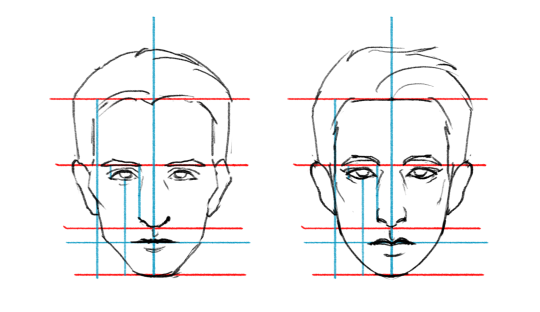
These are the standard proportions of a human head:
When you start tweaking them you get different looking
faces!
You can also take the same proportions and change the shapes
of the features and get a new face as well! Amazing!
So if you want to draw your favorite characters what you can
do is figure out their “facial blueprints” and reference them. Let’s
draw that smarmy bastard Hannibal Lecter. Use as many lines as you need to gauge the spacial relations
between each feature.
What shapes make this face uniquely Hannibal’s?
Let’s apply it all together now.
It takes practice of course but it’s a good way to study the
character’s face! I hope that was somewhat helpful lol Q__Q
finally colored the sketches from yesterday’s stream! (thanks for coming guys~)
forgot who requested who bonez1925 and ldefix requested gamzee and tavros? if i remember correctly dirk was the only one i drew on impulse i think so im dedicating dirk to kitskittle haha <33333
They are the equivalent to strippers here. They never engaged in sex acts but if you look throughout their history they were not treated well. Most being sold into that profession.
If by “here” you mean Japan, i’d just like to say that it is well known that not even the average Japanese citizen is aware of the true nature of the Geisha, Geiko and Maiko. they are not strippers and to say things like this is demeaning to the women who work hard and are trained in the arts (dance, music, tea ceremony, etc.).
Geisha became what they are known as today in the mid-1700s. the first actual geisha were men and they entertained shogun and samurai (and other wealthy men) with dance, music and the art of tea ceremony and theater. when courtesans were losing money to these male geisha, a few of them broke away from being in the sex business and became female geisha. therefore, geisha as an occupation never was a thing of the sex trade/prostitution and absolutely NOT stripping.
let me dispel some common misconceptions:
so, geisha were never prostitutes, never perform sex acts or even accept relationships/marriage proposals until after they retire from being a geisha (usually in their 30s, tho some women stay geisha until death by choice).
while geisha in the past (we are talking almost 100 years ago by now) have been given to Okiya (geisha houses) by their families, it was usually due to the families inability to afford their child and rather than let the child be homeless and starve, they gave them to an Okiya where they would live a much better life (Okiya housed other geisha within that Okiya’s special “familiy”; the Okasan–”Mother”–of the house protected them, gave them a comfortable living, fed them, sent them to all their classes, spent money on their personal kimono and make-up, and who arrange their finances and plan their parties and events). Nowadays, and pretty much since the 1940s, Geisha become Geisha by choice and enter into the profession after they graduate middle school (it is even required in most cases that they complete at least that level of schooling before becoming a Geisha) willingly.
GEISHA wear their Obi belts tied tightly in the back to hold together their Kimono; these belts are so long and heavy that the Okiya hires a male dresser to assist in tying these Obi every night before a party or event. a geisha could not strip or easily take off her many layers of Kimono/undergarments and so the assumption that they are strippers just doesn’t make any sense. a traditional courtesan or TAYUU/OIRAN wore her Obi belt loosely tied in the front so that she could easily untie it for a customer.
There is no empirical evidence of there being any such thing as “mizuage” (as referred to by Arthur Golden in ‘Memoirs of a Geisha’) in the geisha world. there is however evidence of the ritual of mizuage in the Tayuu (or Oiran depending on the region, i think) courtesan tradition. a courtesan who was being initiated would have a ceremony where wealthy men bid for her virginity, with the highest bid being the winner. These Tayuu (or Oiran) are absolutely NOT in any form in relation to a Geisha. i will also mention that prostitution in Japan has been illegal since 1959, officially.
“Comfort Women” from the WWII era were prostitutes that told American GIs that they were “geisha” in order to make more money and to play on the exoticism that was so popular in the US at the time. this is where a big portion of the “Geisha are prostitutes” misconception came from.
“Hot Springs Geisha” and Bar Hostesses in Tokyo are trained in a similar way to traditional Geisha in that they have skills in the art of conversation and even some musical skill, however these women are NOT Geisha. “Hot Springs Geisha” are also known to engage in sex acts with hot springs patrons (though it is frowned upon) and so bring another incorrect image of sex-acts to the name of Geisha.
While there have I’m sure been cases of abuse from an Okasan to her Geisha throughout the history of the profession, this is usually not the case, and to say that “many or all Okasan are abusive and manipulative to their Geisha” is ignorant and offensive.
DO NOT READ “MEMOIRS OF A GEISHA”!! If you already have, I would strongly suggest you read other books on the subject of Geisha. Arthur Golden (a white man) wrote this book to make money off of the many misconceptions about Geisha, Geiko and Maiko. Everything he says about the Geisha tradition is incorrect, from the part where he explains why “some Geisha” wear lipstick only on the bottom lip (this actually signifies that a Maiko has only been in training for under a year) to his horrible, offensive and incorrect description of a Geisha going through mizuage. He interviewed a very well-known geisha named Mineko Iwasaki for his book, which he then exploited and changed around for his benefit. She even tried to sue him for libel for taking stories from her personal life, twisting it and turning it into a book that lies about the fundamentals of being a Geisha. I would recommend reading, “Geisha, A Life” by Mineko Iwasaki. she has written about what it really means to be a Geisha.
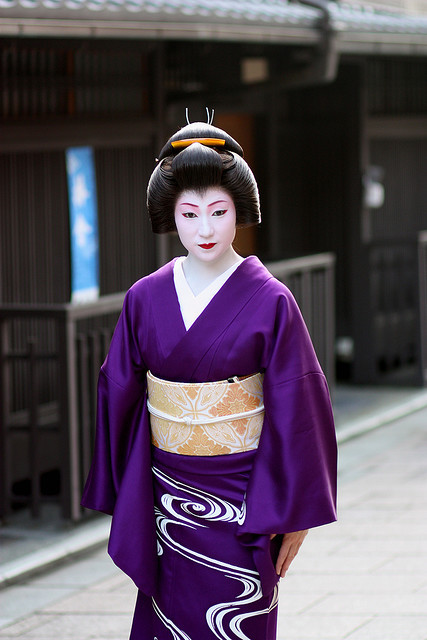
Here are is a picture of a Geiko (a fully-fledged Geisha who has completed most of her training and has become a professional):
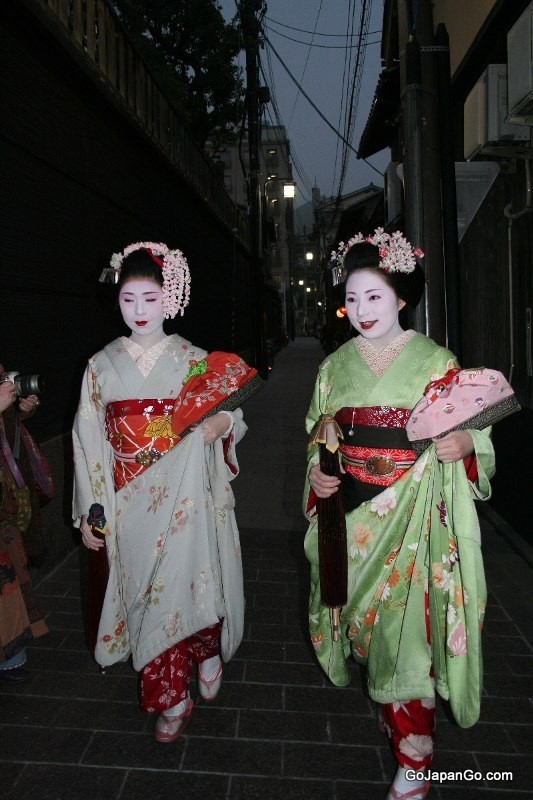
Here is a picture of a Maiko (a Geisha-in-training who is still an apprentice and usually works alongside her “Older Sister” or her assigned Geiko partner; her Older Sister is in charge of most of a Maiko’s social training):
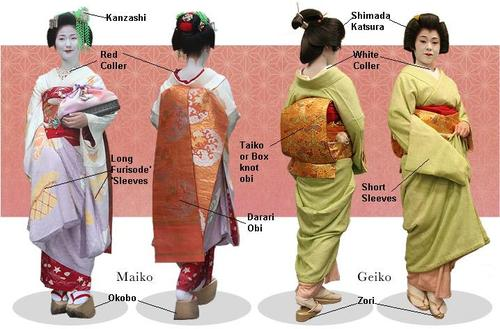
Here is the difference in dress between a Geiko and a Maiko:
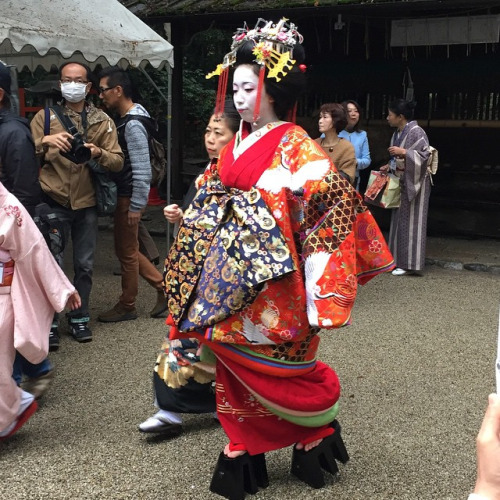
Here is a Tayuu courtesan (high end prostitute); this profession no longer exists, any modern photographs of one is of an actress for historical theater purposes. Notice the Obi belt tied in front and the overall difference in dress. This was what courtesans looked like:
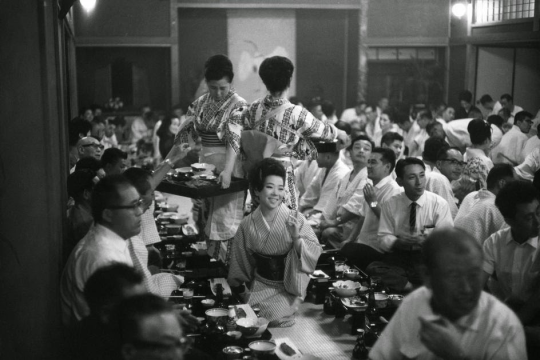
This is a photo of “Hot Springs Geisha” in the 60s. Notice the women serving drinks and entertaining men at the tables:
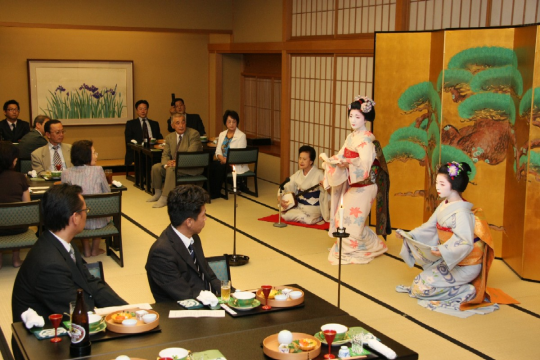
Here is a picture of an Ozashiki (party, event or gathering where Geisha are hired to entertain with music, dance, conversation and drink serving) today. It is much, much, much different (and more expensive) than an average hostess bar, and takes place within an Ochaya (traditional teahouse). As you can see, men are not the only ones who have booked an Ozashiki with Geisha:
Please do not spread misconceptions about these hard-working women artists. They deserve respect and have persevered for centuries with women at the forefront of these professions. Not only are these women trained to entertain party patrons, but they are also highly skilled in theater and the performing arts. Surrounding the Geisha are women wigmakers, female Shamisen, drum, flute ensembles, hairdressers, kimono artisans, well-respected dance/music/tea ceremony teachers, jewelry and hair accessory makers, Okobo and Zori footwear artisans, teahouse staff and Ozashiki planners, instrument craftsmen, and many, many more. If you would like to know more about Geisha, there are many books written by former Geisha out there.
Here is a short video of a Geisha performance, it is the annual Miyako Odori (”Cherry Blossom” Dance):
Capitalism prohibits full employment by marketizing labor. When workers are employed they agree to exchange their labor for a service which has a value based on supply and demand.
Low unemployment means a low supply of available labor means labor costs rise which means a cut in profits.
Instead unemployment will always sit at a point where a consumer class can be maintained but labor costs aren’t too high and the unemployed are punished for being unemployed even though their position is beyond their control.
2. The end of poverty
Part of the punishment for being unemployed (without access to preexisting wealth) is poverty. Workers are coerced to work uncomfortable and long hours in jobs they hate because if they don’t they may be punished with unemployment and therefore poverty.
Furthermore it cannot end because it would necessitate the transfer of wealth from the wealthy to the dispossessed on a level that the wealthy would never agree to.
There will always be the softening of poverty, especially by liberals, but never its end. It is not a glitch, it’s a feature.
3. World peace
Capitalist competition is a subset of Statist competition. States have used several means to compete; including through open warfare (Medieval), ideological competition (Reformation), colonization (Enlightenment), industrialization (laissez faire capitalism), social development (Keynesian capitalism), and finally now global market share (neo-liberalism).
In every stage the precursors are all important and still exist. The foundations of statism and therefore capitalism are on warfare as an acceptable option. Wherever more refined modes of control fail the dominant powers always have brute force lined up as an option.
4. Decolonization
Based on my last point colonization is an important thread in capitalism’s past and present.
5. Full equality of all social classes
As I’ve explained, there will always be poverty under capitalism. There will always be an employing class and and employed class (which has various forms of labor, desirable or not, that further divides it). These classes by definition are unequal.
6. A lastingly stable economy
Capitalist competition means that the producers of goods are constantly trying to capture a larger market. As such they plan and manufacture goods in a way that far exceeds market demand, smothering the price of the good and therefore rendering its production worthless and its producers at a loss.
This often leads to wasteful, backward, and convoluted policies to continue competition far past its usefulness such as subsidies to lower supply, the destruction of excess, controlled release of inventory, purposeful slowing of services/ damage & neglect of infrastructure to excuse consumer cost increases.
7. Abolition/effective reformation of prisons/schools
Capitalism has created a market of cheap state-subsidized labor force from the prison population and benefits greatly from high incarceration rates. The prison system both public and private force the tax-payer to provide the cost of food and shelter for incarcerated citizens, allowing the system to absorb all but pennies on the dollar in their profit from labor while not having to pay for transportation of their finished good outside of the border.
This also has the effect of cheapening the labor of free citizens by lowering demand through a cheaper alternative, much like outsourcing but far more potently.
Schools won’t change because they are the method of indoctrination into capitalism and statism. They are purposefully organized, structured, and long to acclimate children to long and boring work hours doing things they don’t want to do for an unfair boss. They also have the added purpose of providing a common narrative of society and history for all youth and therefore adult population.
8. Ethical consumption
Ethical consumption is not always profitable consumption. Where two companies are producing something with a toxic by-product and all else is equal the company that pays to properly dispose of the toxin will have a disadvantage against that which illegally dumps it.
This echos throughout the system and states have pressures on them to reduce their regulations as much as they do to increase them.
9. Permacultural and fair global food system
Permaculture takes far more time and understanding to accomplish than industrial farming techniques, rendering current agricultural conditions cheaper (at least in the short run, and a corporation is only interested in the next two or three quarters at most).
Capitalism also benefits greatly by forcing foreign nations to produce at lower labor costs to maintain competitiveness with the capitalist core which can produce goods much more efficiently due to it’s more advanced state and capitalist infrastructure.
10. Retirement of all senior citizens
Economies have been shown to expand and decline with the age of their citizens. As far as capitalism is concerned, the elderly are a huge burden and it much better for the system and for statist competition if they bear their own weight. This means if they have not yet earned enough money to take care of themselves for the rest of their lives then they must continue to sell their labor, which depreciates in value with their declining health and advancing age.
11. Functional anarchy (looking at you, an-caps)
By which I mean a horizontal system with no extreme hierarchy and all members are relatively equal.
Capitalism implies an owning class and a non-owning (working) class. Which are inherently uneven.
There have been various examples, btw, of functional anarcho-communism throughout native communities around the world and also in western history in groups such as the Cathars of Medieval france or later the Spanish Confederación Nacional del Trabajo (CNT). Usually they stop working when capitalists and fascists come in to wreck their shit.
12. Free association
The divisions of class both economic and social which are inherent to capitalism will never allow people to associate free of consequence. Furthermore, barriers are set up to keep the poor and dispossessed in areas that are away from the wealthy and celebrated.
Separate school systems, separate college systems, separate work environments, separate restaurants and clubs, separate neighborhoods and towns. The list goes on.
Furthermore, people must work, so they are forced to associate with their coworkers and sometimes customers and clients.
13. Direct democracy
Direct democracy cannot work in an unequal system. The inertia of their economic power will always allow capitalists a special role in policy dictation which undermines the very roots of direct democracy, equal representation.
How are there more than just two genders?
How is it that gender is different from sex?
Why would you consider gender to be a social construct?
How is gender a spectrum?
Why do you feel the need to disassociate gender and sex when biologist have already proved that gender and sex are the same thing?
Personally speaking, I don’t understand why anyone would want to try and push gender identity shit down other people’s throats in the most radical way possible, but it’s fucking annoying as hell. To think that you know better than what biologist have studied for years makes me question your intelligence.
Here’s some food for thought people:
XX chromosomes = Female
XY chromosomes = Male
Penis = Male
Vagina = Female
Testosterone = Male
Estrogen + Progesterone = Female
Gender = Sex
Until you can come up with a reason as to why gender isn’t biological and why I’m a piece of shit for not believing your bullshit, then please stop trying to change around shit just because you hate to hear the opposing voice and accept the facts as they are.
This is an open response to those who believe in the multiple genders/gender spectrum bullshit.
oh, you’re in for a hell of a ride. (and don’t worry, there will a TL;DR at the bottom of this post just in case you’re too lazy to read or are simply unwilling to have your ignorant worldview dismantled by actual concrete facts.)
first, let’s look into the social construction of gender and the gender binary.
the narrow-minded idea that there are only two genders has been continuously debunked by biologists, psychologists, anthropologists, and doctors alike, first of all. second, gender and sex are not the same thing, but they are both the same in the sense that they are both social constructs made to describe natural phenomenon, not actually based in any scientific reality.
gender is only your sense of, and internal mental relationship to masculinity, femininity, and androgyny, which can be expressed through words, behavior, or clothes. this does not actually have anything to do with biology—even less so than sex. there is no scientific, biological, or medical basis for a binary system of gender, and in fact the gender binary completely contradicts the laws of natural variation.
each person’s deeply felt internal and individual experience
of gender, which may or may not correspond with the sex assigned at birth, including the personal
sense of the body (which may involve, if freely chosen, modification of bodily appearance or
function by medical, surgical or other means) and other expressions of gender, including dress,
speech and mannerisms.”
there is no limitation on who you are and what
identity you construct for yourself. since it is a socially defined
construct, people can and do construct more than the two traditional genders,
and all are valid.
– “Sociological
explanations, in turn, often fail to recognize that gender beliefs are
influenced by individual-level factors. For example, people differ in the
extent to which they hold gender identities, or personally identify with a sex
category. Although identities often reflect categories of male or female, they
also may include alternatives (e.g., intersex, transgender). The specific
content of gender identities can include communal or agentic personality
attributes, gender-typed interests and occupations, or gendered ways of
relating to others (Wood and Eagly 2009). Men and women act in gendered ways as
they regulate their behavior in line with a valued gender identity (Witt and
Wood 2010; Wood et al. 1997). Thus, people may do gender because it enhances
their self-esteem and positive feelings.” (p.g. 337)
– “If gender is the
cultural meanings that the sexed body assumes, then a gender cannot be said to
follow from a sex in any one way. Taken to its logical limit, the sex/gender
distinction suggests a radical discontinuity between sexed bodies and
culturally constructed genders. Assuming for the moment the stability of binary
sex, it does not follow that the construction of ‘men’ will accrue exclusively
to the bodies of males or that ‘women’ will interpret only female bodies.
Further, even if the sexes appear to be unproblematically binary in their
morphology and constitution (which will become a question), there is no reason
to assume that genders ought also to remain as two. The presumption of a binary
gender system implicitly retains the belief in a mimetic relation of gender to
sex whereby gender mirrors sex or is otherwise restricted by it. When the
constructed status of gender is theorized as radically independent of sex,
gender itself becomes a free-floating artifice, with the consequence that man
and masculine might just as easily signify a female body as a male one, and
woman and feminine a male body as easily as a female one.” (p.g. 10)
– “All of which brings me back to the five sexes. I
imagine a future in which our knowledge of the body has led to resistance
against medical surveillance, in which medical science has been placed at the
service of gender variability, and genders have multiplied beyond currently
fathomable limits. Suzanne Kessler suggests that ‘gender variability can… be
seen… in a new way—as an expansion of what is meant by male and female.’
Ultimately, perhaps, concepts of masculinity and femininity might overlap so
completely as to render the very notion of gender difference irrelevant.” (p.g.
101)
– “Given the
discrimination and violence faced by those whose cultural and physical genitals
don’t match, legal protections are needed during the transition to a
gender-diverse utopia. It would help to eliminate the ‘gender’ category from
licenses, passports, and the like. The transgender activist Leslie Feinberg
writes: ‘Sex categories should be removed from all basic identification
papers—from driver’s licenses to passports—and since the right of each person
to define their own sex is so basic, it should be eliminated from birth
certificates as well.’ Indeed, why are physical genitals necessary for identification?
Surely attributes both more visible (such as height, build, and eye color) and
less visible (fingerprints and DNA profiles) would be of greater use. Transgender
activists have written ‘An International Bill of Gender Rights’ that includes
(among ten gender rights) ‘the right to define gender identity, the right to
control and change one’s own body, the right to sexual expression and the right
to form committed, loving relationships and enter into marital contracts.’’90
The legal bases for such rights are being hammered out in the courts as I
write, through the establishment of case law regarding sex discrimination and
homosexual rights.” (p.g. 111)
just
because you cannot handle your societally constructed worldview surrounding
sex, gender, and genetics being smashed by sociology & biology itself
doesn’t mean, additionally, that you have the right to make other people feel
unsafe and uncomfortable just because
you don’t like having your world view being dismantled. the
complexities of human behavior & the diversity of sex and reproduction in
life cannot all be covered in a simple high school biology class. shocker!
now, let’s move on to the social construction of “biological” sex.
even if gender was the exact same thing as sex, it still
wouldn’t be a binary or a scientific absolute. despite the name “biological sex,” sex isn’t a biological fact
either. Anne Fausto-sterling, PhD, is one of many biologists who has
written literature explaining the social construction of “biological” sex (see: Sexing the Body, 2000, and her previous book, Myths of Gender, 1985). in the novel Sexing the Body, Fausto-Sterling explains that there are 5 specific measures of
“biological sex” according to modern medical science:
1. chromosomes (male: XY, female:
XX)
2. genitalia (male: penis, female vulva and vagina)
3. gonads (male: testes, female: ovaries)
4. hormones (male: high testosterone, low estrogen, low
progesterone; female: high estrogen, high progesterone, low testosterone)
5. secondary sex characteristics (male: large amounts of dark,
thick, coarse body hair, noticeable facial hair, low waist to hip ratio, no noticeable
breast development; female: fine, light colored body hair, no noticeable facial
hair, high waist to hip ratio, noticeable breast development)
in real life,
very few people actually match up with all five categories. estimates by the
intersex society of north america notes the frequency and prevalence of intersex conditions, and puts the total rate of human bodies that “differ from
standard male or female” at around one in 100, while anne fausto-sterling
estimates that 1.7% of the population do not fall within the usual sex
classifications. there are lots of people out there with XY chromosomes, testes, a
vulva, a vagina, “female” secondary sex characteristics, and “male” hormone
patterns; people with XX chromosomes, testes, a penis, “male” secondary
characteristics and “female” hormone patterns, and there are even people with both “male” and “female” secondary sex characteristics or hormone patterns at the same
time, regardless of their genes, gonads, or genitalia. now, these people are technically intersex
assuming that the two sex system is absolutely true. however, in order for the
binary to even be considered real, every single person on earth must completely match up on
all 5 markers of sex all the time. that’s not what happens in real life. in
real life, literally MILLIONS of people have bodies that are contrary to the
biological concept of the two sex system.
to illustrate further, let’s look further into fausto-sterling’s book and consider the case of the athlete maria patiño. patiño
has “female” genetalia, and she has
always considered herself to be female and was considered so by others.
however, she was discovered to have XY chromosomes and was barred from
competing in women’s sports. patiño’s genitalia were at odds with her
chromosomes and the latter were taken to determine her sex, and she successfully
fought to be recognized as a female athlete, arguing that her chromosomes alone
were not sufficient enough to not make her female. intersex people, like
patiño, illustrate that our understandings of sex differ and suggest that there
is no immediately obvious way to settle what sex amounts to purely biologically
or scientifically. deciding what sex is involves evaluative judgements that are
influenced by social factors.
citations from other works of literature:
• Judith Lorber, Believing is Seeing: Biology as Ideology; from Gender and Society, Vol. 7, No. 4 (1993) – “Until the eighteenth century, Western philosophers and scientists thought that there was one sex and that women’s internal genitalia were the inverse of men’s external genitalia: the womb and vagina were the penis and scrotum turned inside out.” (p.g. 568)
– “…the social construction of the conventional sex and gender categories already assumes differences between them and similarities among them. When we rely only on the conventional categories of sex and gender, we end up finding what we looked for-we see what we believe, whether it is that ‘females’ and ‘males’ are essentially different or that ‘women’ and ‘men’ are essentially the same.” (p.g. 578)
•
Anne Fausto-Sterling, Sexing the Body: Gender Politics and the
Construction of Sexuality (2000)
– “Consider Angela Moreno’s more
recent tale. In 1985, when she was twelve years old, her clitoris grew to a
length of 1.5 inches. Having nothing to compare this to, she thought she was
normal. But her mother noticed and with alarm hauled her off to a doctor who
told her she had ovarian cancer and needed a hysterectomy. Her parents told her
that no matter what, she would still be their little girl. When she awoke from
surgery, however, her clitoris was gone. Not until she was twenty-three did she
find out she was XY and had had testes, not ovaries. She never had cancer.21
Today Moreno has become an ISNA activist and credits ISNA with helping her heal
psychologically from the damage done by lies and surgery. She dreams of
teaching in a Montessori school and perhaps adopting a child. She writes: ‘If I
had to label myself man or woman, I’d say, a different kind of woman… . I’m
not a case of one sex or the other, nor am I some combination of the two… and
from the bottom of my heart, I wish I’d been allowed to stay that way.’” (p.g.
84)
– “We stand now at a
fork in the road. To the right we can walk toward reaffirmation of the
naturalness of the number 2 and continue to develop new medical technology,
including gene ‘therapy’ and new prenatal interventions to ensure the birth of
only two sexes. To the left, we can hike up the hill of natural and cultural
variability. Traditionally, in European and American culture we have defined
two genders, each with a range of permissible behaviors; but things have begun
to change. There are househusbands and women fighter pilots. There are feminine
lesbians and gay men both buff and butch. Male to female and female to male
transsexuals render the sex/gender divide virtually unintelligible.” (p.g. 101)
• Monique Wittig, “One Is Not Born a Woman”
– “At this point, let us say that a new personal and subjective definition for all humankind can only be found beyond the categories of sex (woman and man) and that the advent of individual subjects demands first destroying the categories of sex, ending the use of them, and rejecting all sciences which still use these categories as their fundamentals (practically all social sciences).” (p.g. 19-20)
-“One of
the most important developments in early 1990s’ anglophone feminist theory is
seen to be the destabilisation of the apparent orthodoxy regarding the
relationship between sex and gender. It is no longer assumed that sex is a
‘natural’ or ‘biological’ category, with gender a social or cultural
construction somehow imposed on top of it. ‘Sex’ is increasingly recognised as
a sociohistorical product, rather than a fixed, transhistorical, or
taken-for-granted category.” (p.g. 15)
– “The
Category of Sex’ (first published in 1982) provides an excellent brief
introduction to the key ideas shared by the group. In it, Monique Wittig, a
novelist and literary theorist, argues that the division of society into two
sexes is the product, and not the cause, of oppression; that ‘sex’ is a
political category and there would be no ‘sex’ without oppression; and that
heterosexuality is of central importance in defining the sexes as natural,
different and complementary.” (p.g. 16)
•
Maria Lugones, “The
Coloniality of Gender” (2008)
– “Sex is still presumed
to be binary and easily determinable by an analysis of biological factors.
Despite [countless] anthropological and medical studies to the contrary,
society presumes an unambiguous binary sex paradigm in which all individuals
can be classified neatly as male or female.” (p.g. 6)
•Anonymous Author, “The Problematic Ideology of Natural Sex” (2016)
– “Around the world, over the past four or five hundred years,
people have been cajoled, threatened, forcibly re-educated, beaten, imprisoned,
locked in mental hospitals, put in the stocks, publicly humiliated, mutilated,
and burnt at the stake for violating one or more of the precepts of ‘Natural [Biological] Sex.’ That’s the sure sign of enforced ideology, not a true natural law…”
– “If we truly believe in science, in a rational world where we
look objectively at what is, rather than impose our beliefs onto reality, then
we need to reject the Ideology of Natural Sex. We need to see the reality of
the sex spectrum and stop framing intersexuality as a rare disorder that
somehow violates natural law. We need to understand that different societies
have divided the sex spectrum up into different numbers of social sexes, and
that binary sex is no more or less arbitrary than trinary or quartic sex
systems…”
– “It is no surprise,
then, that the sex binary is so firmly rooted in Euro-American thought, along
with many others (think body and mind, nature and culture). It underpins and
naturalises gendered divisions of labour through, for example, the notion of
women as the weaker sex. Language mirrors the distinction between male and
female, as in the way we talk about the sexes as ‘opposite’, and throughout
life we are encouraged to think in binary terms about this central aspect of
our existence.”
– “While these gendered
binaries play out in social life in reasonably clear ways, they also seep into
places conventionally seen as immune to bias. For example, they permeate sex
science. In her paper ‘The Egg and the Sperm’ (1991), the anthropologist Emily
Martin reported on the ‘scientific fairy tale’ of reproductive biology… scientific knowledge is produced in culturally patterned ways and, for
Euro-American scientists, gendered assumptions make up a large part of this
patterning.”
– “
In Gender Trouble (1990), the feminist theorist Judith Butler argues that the insistence on sex as a natural category is itself evidence of its very unnaturalness. While the notion of gender as constructed (through interaction, socialisation and so on) was gaining some acceptance at this time, Butler’s point was that sex as well as gender was being culturally produced all along. It comes as no surprise to those familiar with Butler, Martin and the likes, that recent scientific findings suggest that sex is in fact non-binary. Attempts to cling to the binary view of sex now look like stubborn resistance to a changing paradigm. In her survey paper ‘Sex Redefined’ (2015) in Nature, Claire Ainsworth identified numerous cases supporting the biological claim that sex is far from binary, and is best seen as a spectrum. The most remarkable example was that of a 70-year-old father of four who went into the operating room for routine surgery only for his surgeon to discover that he had a womb.”
– “All of these
different manifestations of sex layer onto each other, so people might go their
whole lives without knowing that they have cells or even organs of the
‘opposite’ sex.”
– “Looking to other
times and to other cultures, we are reminded that sex is to some degree
produced through the assumptions we make about each other and our bodies.
Modern science is moving towards consensus on sex as a spectrum rather than a
simple male/female binary, and it is time to start casting around for new ways
of thinking about this fundamental aspect of what we are. Historical and
anthropological studies provide a rich resource for re-imagining sex, reminding
us that the sex spectrum itself is rooted in Euro-Western views of the person
and body, and inviting critical engagement with our most basic biological
assumptions.”
– “For quite different
reasons, Catharine MacKinnon argues explicitly that gender is the division of
men and women caused ‘by the social requirements of heterosexuality, which institutionalizes male sexual
dominance and female sexual submission’; sex-which comes to the same thing-is
social relations ‘organized so that men may dominate and women must submit.’
‘Science’, Ruth Bleier argues, mistakenly views ‘gender attributions as natural
categories for which biological explanations are appropriate and even necessary.’
Thus some of the so called sex differences in biological and sociological
research turn out to be gender differences after all, and the distinction
between nature and culture collapses as the former folds into the latter.”
(p.g. 13)
r
“biological sex” is just as biased,
unscientific, and subjective as the concept of gender is, and to base sex or gender on chromosomes or genitals or some other
arbitrary feature is to ignore and marginalize the truth. there are millions of
people who have different genitalia, lack them all together, or are intersex, people with differing karyotypes (i.e. XXY, XXX,
XYY, X, etc) or chimerism (a body where some cells are of one karyotype and
others are of another), and there are people with all kinds of genetic/epigenetic/biological conditions. these are all normal, natural
variations of the human body that aren’t inherently connected to each other. to
say sex or gender is defined by any of these features is erasive, intersexist,
transphobic, and entirely contrary to what actual biologists and geneticists
have been saying for decades.
you can also check out this lovely post explaining the social construction of both human sex and gender.
not to mention, the idea of a gender binary is a very, very recent concept rooted in colonialism and racism, not “science” or “biology”.
in fact, the idea of third and nonbinary genders is as old as human civilization. (the list below is a very VERY brief history of nonbinarism):
§ 2000 BCE: in mesopotamian mythology, among the earliest written records, there are references to types of people who are neither men nor women. in a sumerian creation myth found on a stone tablet from the 2000 bce, the goddess ninmah fashions a being “with no male organ and no female organ”, for whom enki finds a position in society: “to stand before the king".
§ 1800 BCE: inscribed pottery shards from the middle kingdom of egypt, found near ancient thebes, list three human genders: tai (male), sḫt (“sekhet”) and hmt (female).
§ 385-380 BCE: aristophanes, a comic playwright, tells a story of creation in which “original human nature” includes a third sex. this sex “was a distinct kind, with a bodily shape and a name of its own, constituted by the union of the male and the female: but now only the word ‘androgynous’ is preserved.”
§ 77 BCE: genucius, a roman slave is denied inheritance on the grounds, according to art historian lynn roller, of being “neither a man nor a woman.” he is “not even allowed to plead his own case, lest the court be polluted by his obscene presence and corrupt voice.”
§ 1871: british administrators pass the criminal tribes act in india, effectively outlawing the country’s hijras—a community that includes intersex people, trans people, and even cross-dressers. celebrated in sacred indian texts, hijras had long been part of south asian cultures, but colonial authorities viewed them as violating the social order.
§ 1970: mexians in oaxaca state establish vela de las intrepidas (vigil of the intrepids), a festival celebrating ambiguous gender identities. the zapotec culture embraces a third-gender population called muxes. muxes trace back to pre-columbian times, when there were “cross-dressing aztec priests and mayan gods who were male and female at the same time”.
§ 2014: india’s supreme court recognizes the right of people, including hijras, to identify as third-gender. the court states, “it is the right of every human being to choose their gender.”
this binary gender system of ours is comparatively very new, and has been
forced upon the rest of the world by white europeans in destructive and
violent invasion, genocide, and complete appropriation and destruction of the original cultures
of each land. really, it is the binary system that is unnatural. multiple genders have always existed in this world. and despite the best attempt of european colonialists, they continue to exist today, indicating that it is part of human nature to not fit in a neat binary and instead have multiple genders. there are multiple countries today that have either no genders at all, or three or more genders officially recognized, and there are many languages where gendered pronouns and categories don’t even exist. even within the united states, some native american tribes have a system of gender that include up to six distinct genders.
– “Lugones introduces a systemic
understanding of gender constituted by colonial/modernity in terms of multiple
relations of power… gender itself is a colonial introduction, a violent
introduction consistently and contemporarily used to destroy peopks,
cosmologies, and communities as the building ground of the ‘civilized’ West.”
(p.g. 186)
– “As global, Eurocentered capitalism
was constituted through colonization, gender differentials were introduced
where there were none. Oyeronkk Oyewhmi has shown us that the oppressive gender
system that was imposed on Yoruba society did a lot more than transform the
organization of reproduction… many Native American tribes
were matriarchal, recognized more than two genders, recognized ‘third’
gendering and homosexuality positively, and understood gender in egalitarian
terms rather than in the terms of subordination that Eurocentered capitalism
imposed on them. Gunn’s work has enabled us to see that the scope of the gender
differentials was much more encompassing and it did not rest on biology.”
(p.g. 196)
•Anne Fausto-Sterling, Sexing the Body: Gender Politics and the Construction
of Sexuality (2000)
– “Were we in Europe and America to
move to a multiple sex and gender role system (as it seems we might be doing),
we would not be cultural pioneers. Several Native American cultures, for
example, define a third gender, which may include people whom we would label as
homosexual, transsexual, or intersexual but also people we would label as male
or female. Anthropologists have described other groups, such as the Hijras of
India, that contain individuals whom we in the West would label intersexes,
transsexuals, effeminate men, and eunuchs. As with the varied Native American
categories, the Hijras vary in their origins and gender characteristics.
Anthropologists debate about how to interpret Native American gender systems.
What is important, however, is that the existence of other systems suggests
that ours is not inevitable.” (p.g. 108-109)
– “Colonialism as practiced by Western
culture is used to erase traditional non-binary roles of gender orientation and
systems of sexuality, i.e. the Two-Spirit. Identifying as Two-Spirit becomes
not just a traditional way of expressing Indigenous beliefs of gender
orientation and sexuality but a political identity in resistance of
colonialism. Through the use of inherently violent, assimilative measures,
these traditions of the Two-Spirit in Indigenous societies are lost in many of
our communities and are replaced by the Western gender binary and spectrum of
sexual orientation. As this paper will show, this plays into the colonialist
logic of white supremacy and how it relates to the Indigenous body, colonizing
Two-Spirit identity.” (p.g. 1)
– “When Europeans came to Turtle
Island, much of their culture, their ideals, their beliefs and institutions
came with them through the continued centuries of settler-colonialism. Building
their own nation upon this land, they were able to more permanently construct
and impose their culture upon others. The Western colonization of the Americas
brought forth many institutions which sought to erase and displace Indigenous
cultural traditions and beliefs. Through the use of violence, forced
assimilation, demonization of Indigenous beliefs and then appropriation of
Indigenous culture, the subjugation of Native sexuality and gender roles have
continued unquestioned in the minds of the settler and of our own people. It
can be said and will be shown, that the Western binary is a system of
oppression and repression and is actively a form of institutional violence
against the Two-Spirit. This is all connected to the idea of white supremacy
and domination over Indigenous bodies and beliefs, of colonization of our very
selves. Thus an analysis of colonization and white supremacy is not complete
without an approach towards Two-Spirit identity in our own communities.” (p.g.
1-2)
– “Before
the colonization of this land, there were as many as six traditional gender
orientation roles among numerous tribes. However, due to boarding schools erasing
these traditions […] the Christianized related the existence of the Two-Spirit
as sin… The Western Gender Binary is thus superimposed upon all cultures and
their histories seen through the gaze of not only male dominance but a
male/female paradigm that does not account for the existence of third, fourth,
fifth and even more varieties of non-male/female expressions and identities. […]
The Western Gender Binary does not see the Two-Spirit, the Western Gender
Binary only sees a Man acting in ‘Unmanly’ ways or a Woman acting in
‘Unwomanly’ ways… The influence of Western culture on the erasure of Indigenous
“queer” and Two-Spirit peoples has created a system of sexual assault,
homophobia and transphobia used against our peoples, entangled with the history
of colonialism. As part of the settler mentality, we can see these actions as
colonial violence against the Two-Spirit and are also the results of genocide.
To reiterate previous statements, the Western gender binary is a form of
superimposed and universalized colonialism upon Indigenous bodies and minds.”
(p.g. 5-6)
•Anonymous Author, “The Problematic Ideology of Natural Sex” (2016)
– “…we have ignorance of the long and violent history of the imposition of the Ideology of Natural Sex under European colonialism. The genius behind framing an ideology as ‘natural’ is that its history erases itself. Why would anyone study the history of something natural and eternal? We don’t study the history of covalent bonds in chemistry or cumulus clouds in meteorology. And so we don’t study the spread of European binary sex ideology under colonialism. If you do, you’ll find that all over the world before European colonialism there were societies recognizing three, four, or more sexes and allowing people to move between them—but that’s a subject for another post. Suffice it to say that societies were violently restructured under European colonialism in many ways, and one of those was the stamping out of nonbinary gender categories and stigmatization of those occupying them as perverts.”
to say that nonbinary genders don’t exist would not only be scientifically incorrect and historically inaccurate, but it would be to say that the cultural traditions of these people are invalid, and only the white european standard of gender, which was forced onto indigenous people via genocide and forced assimilation, is “correct”. trying to enforce western concepts of gender on other cultures is an act of blatant racism and imperialism, and presumes that one group somehow knows more about the human condition.
neither gender nor biological sex is innate, binary, or a scientific reality in any way, and the vast majority of biologists, scientists, doctors, psychologists, historians and anthropologists have been debunking these ignorant claims for decades and proving that both of these concepts are socially constructed. since gender as completely subjective, nonbinary genders have existed since the dawn of human civilization, even dating back to mesopotamia, the VERY FIRST human society. there are many countries today where there are officially more than two genders recognized, and there are multiple languages that are entirely gender-neutral. the gender binary is an entirely european theory based on a complete lack of understanding of science, and was forced on the world via colonialism, violence, and genocide. saying that nonbinary genders aren’t real is an act of transphobia, racism, and imperialism, and is the same as saying that thousands of cultures, personal experiences, and entire societal structures throughout history are not real, which makes no sense. it is part of human nature to not fit in a neat binary.
but you know, curse those special snowflakes, or whatever.
This right here, is art.
How in the holy fuck nuggets does this not have more notes
((Im gonna need to start saving because this entire post is going on my gravestone
Do not talk about an obviously disabled person in front of them as if they can’t hear or understand you.
Do not talk to a disabled person’s companion instead of them.
Ask permission before touching people, or their wheelchairs/other equipment. Even if you want to help.
Ask disabled people about their lives and really listen to their answers. (Within reason. Asking people personal questions about their sex lives, for example, is rude unless you are very close to them and they’ve communicated they’re OK with that).
Listen to what they say whether they are speaking, writing, typing, using text to speech, using a letterboard, using PECS, gesturing, using sign language, or using any other form of communication. People who cannot speak can still communicate.
Stand up for people you see getting bullied.
Understand that disabled people don’t just need friends, they can be friends, too.
Every public place does not need to have loud, blaring music and TVs with flashing screens.
If you blog, put bright, flashing images that can trigger seizures under a cut so that people with seizures can avoid looking at them.
If a job can possibly be done without a person driving, don’t require candidates to drive/have a driver’s license, and don’t interview candidates and then reject them because they don’t drive.
When talking to someone who has trouble speaking or stutters, and takes a long time to speak, wait for them to answer. Don’t keep repeating the question or pressuring them. Yes, if you’re like me and your mind is going really fast and you forget what people are saying if they take too long, it can be hard to be patient. Do it anyway.
If you are talking to a deaf person, make it easier for them to lip-read by facing towards them while looking at them, and not covering your mouth with your hands.
If you are talking to someone with hearing impairment or auditory processing disorder, it is more helpful to slow down or rephrase what you’re saying than to just speak more loudly.
Some disabled people have difficulty understanding nonliteral language such as metaphors and idioms (e.g., “a stitch in time saves nine”). If you’re talking to someone like this, try explaining what you mean by these figures of speech, or just not using them.
Recognize that failure to make eye contact does not mean someone is lying to you. It may be uncomfortable for them.
Recognize that unwillingness to go out to loud, crowded bars does not mean someone isn’t interested in socializing with you.
If people have difficulty spelling, or using the appropriate jargon/terminology for your social group, do not assume they’re stupid. You may need to paraphrase some “jargon” for them.
Recognize that a person can need time alone and it doesn’t mean they don’t like you or want to be with you. It’s just something they need so they can function at their best.
If a person does not recognize you, do not assume they don’t care about you. They may be face-blind.
If a person does not remember your birthday (or other major names, numbers, or dates) do not assume they don’t care about you. They may simply have a bad memory.
Understand that a disabled person’s talents, however esoteric, are real, not unimportant “splinter skills.”
Colorblindness affects more than just knowing what color something is. To a colorblind person, colors that they can’t see will look the same if they have the same degree of lightness/darkness. That means that to a red-green colorblind person, a red rose on a green background will blend in instead of contrast starkly, and the Chicago CTA El map will be difficult to understand. Understand that something that stands out to you and seems obvious may literally not be visible to a colorblind person.
Accept stimming.
Don’t tell them “but you look so normal.” But, if they accomplish something you know they were working really hard to do, it’s great to compliment them on it.
Understand that a person can be working incredibly hard to do something and may still not perform as well as you’d like them to, as well as the average person would, or as well as the situation demands.
If someone has a major medical problem, disability, or chronic illness, then just eating some special healthy diet or exercising more isn’t going to cure it. It might help, it might hurt, it might do nothing, but they’ve probably heard it before, and it’s none of your business in any case.
A person with OCD knows that checking or counting or whatever compulsion they perform won’t really prevent disaster from happening, it’s just a compulsion. That doesn’t stop them from feeling the need to do it anyway. A person with anxiety may know at least some of their fears are irrational or unlikely to occur. That doesn’t stop them from feeling anxious. A person with trichotillomania may know it hurts them to pull out their hair or pick at their skin, but they have trouble stopping themselves anyway. A depressed person may know they would feel better if they got out of their house and talked to people, but that doesn’t make them feel any more up to doing those things. A person who hallucinates may know the hallucinations aren’t real, but that doesn’t make them go away or feel less upsetting. You see the pattern? You can’t cure people with mental illnesses by telling them they’re being irrational or hurting themselves. If it were that easy, they’d have cured themselves already.
Do not tell a person with ADHD or mental illness that they should not be taking medication. This is a personal decision. Furthermore, since medications have wide-ranging effects on people’s bodies and minds and often unpleasant side effects, most people taking medications have thought through the issue, done a cost-benefit analysis, and decided that the ability to function better is worth it. Their decision should be respected.
A disabled person with intellectual disability who has the academic or IQ abilities of, say, a seven year old does not actually have the mind of a seven year old. They have different life experiences, needs, stages of life, bodies, and so on.
If a disabled person is having a meltdown, they are not angry, they are terrified. They’re not throwing a tantrum or being aggressive, they have gone into fight or flight. The best thing you can do is remain calm yourself and help them calm down. It may help to keep your distance, keep your voice low and calm, let them retreat to a safe place if they know to do that, or remind them to do so if they don’t. Reasoning with them won’t work well because they’re unlikely to be able to hear and understand you. The worst thing you can do is start yelling yourself, threatening them, be violent to them, cut off their escape route, or get right up in their personal space.
Other ideas? Please reblog and add more. The more the merrier.






 queerhomestuck