wellamarke:

actorwriterstrangler:

wellamarke:

actorwriterstrangler:

wellamarke:

actorwriterstrangler:

wellamarke:

actorwriterstrangler:

wellamarke:

actorwriterstrangler:

wellamarke:

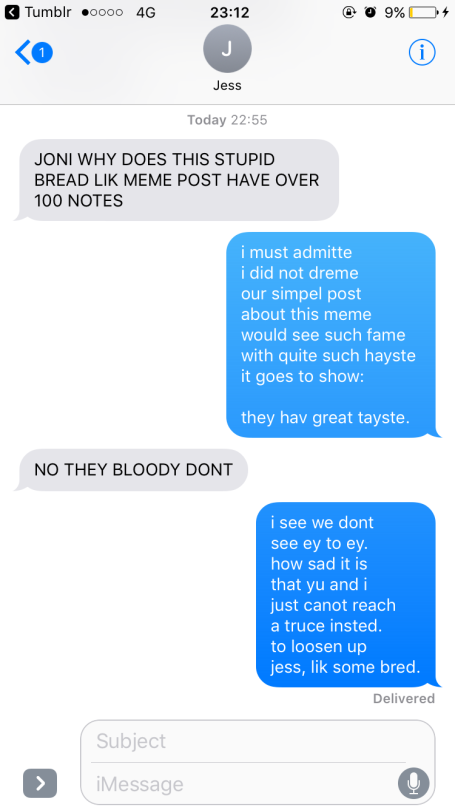
the first complaynts
are coming in:
jess thinks my rimes
are but a sin.
she canot see
the meme’s apeel.
the bredlik love
she does not feel.

why are you like this

the way i am
i will admitte
makes little sence:
i am a twitte.
but who is werce-
the crazy gal
or she who kepes her
as a pal?

why must you

i must becos
this simpel meme
is now my lyf,
my waking dreme.
if i should try
to speke in prose
the cow appears:

he liks my nose.

are you kidding me

i kid yu not.
i shall not tire.
to rime this way
is my desire.
the world may bern
or floode insted:
but i’ll be here
to lik some bred.

please stop

even your tags were in lik the bred format

i give up

this post has killed me

just yesterday
the words above
were sed by jess
who has no love 
for any childe
made up of rime.
she may yet change.
i’ll give her tyme. 

Masterpost: Sensory differences

scriptautistic:

If you know a bit about autism, or have been following this blog for some time, you must be aware that one of the autistic traits which has the most consequences on our daily lives is our sensory differences. They have an impact on all spheres of our lives: on what we can and cannot do, on where we can and cannot go, on what we can eat, wear, listen to, on our ways to feel good and on what makes us feel bad.

Such a wide subject definitely warrants a masterpost. So, here we go!

First, let’s take a look at the human sensory system, to understand the different areas in which there can be differences. It’s actually more complicated than the traditional five senses! Our sensory system is divided into three parts:

  • Exteroception : sensing what comes from the environment outside your body.
  • Interoception : sensing the internal physiological condition of your body
  • Proprioception : sensing the position your limbs and body are in

These three main areas encompass different senses (note that this is one model and others exist):

  • Exteroception: sight, hearing, smell, taste, touch, but also thermoception (sensation of heat/cold) and nociception (sensation of pain)
  • Interoception: nociception (internal pain), feelings of hunger, lack of oxygen, thirst, need to pee, as well as monitoring of the respiratory rate and heart rate.
  • Proprioception: the kinesthetic sense (knowledge of the movement and relative positions of your body parts) and the vestibular sense (knowledge of body movement, direction and acceleration)

For all of these senses, autistic people can have them work typically, be hyposensitive (less sensitive than most people), be hypersensitive (more sensitive than most people) or have sensory processing differences which do not fall under the hypo/hyper system.

The clinical term which encompasses these differences is “Sensory Processing Disorder”. One can have SPD without being autistic, but all or almost all autistic people have SPD.

It should be noted, however, that some autistic people don’t like to think of it as a disorder and prefer simply talking about sensory processing differences.

Something very important to understand is that hypersensitivity and hyposensitivity CAN coexist in any one person’s sensory system. For example, they might be hypersensitive to smell and hyposensitive to touch. They can also be hyper/hypo sensitive to only one aspect of one sense (for instance, pressure or texture or bright lights or sweet tastes). They can also be sometimes hyposensitive to something, and sometimes hypersensitive to it.

Being hypersensitive to a stimulus and being exposed to it can cause what is called “sensory overload”, which usually translates to pain, discomfort, and impaired cognitive functions (in other words, trouble thinking properly). If pushed further (very intense stimuli or very long exposition), it can lead to a shutdown or meltdown.

Being hyposensitive to something and lacking stimulation can translate to restlessness, discomfort, and even pain, as well as an intense craving for the stimuli.

Here are some examples of what hypersensitivity to different senses can translate to, on a behavioral and subjective level:

  • Sight: The person wears sunglasses, maybe even indoors. They avoid places with fluorescent lightning, blinking lightning or too bright lightning. They dislike looking at brightly colored surfaces. They may have trouble with visually cluttered spaces, such as crowds and supermarkets. They may find any kind of flickering or movement around them painful to see.

  • Hearing: They may hear sounds no one else can hear (and some have been tested to hear outside the normal human range). They may have to wear headphones/ear defenders in noisy places. They may avoid crowds and events with lots of people/loud music/shouting. They may have difficulty with the noise of the vacuum, of the construction work on the other side of the street, of the clock ticking in the next room. They may develop tinnitus eventually.

  • Smell: They’ll probably dislike places with strong smells such as perfume shops, farms, or crowded public transportation. They may need to wash themselves, their clothes and their sheet very often to keep body odors to a minimum. They may not tolerate scented soap, shampoo or deodorant (and it’s sometimes difficult to find an unscented one!). They may struggle with the smell of food in general, or with particular smells.

  • Taste: They may be very picky eaters, only tolerating a couple of very bland-tasting food such as mashed potatoes or pasta. They may have difficulty having diverse enough diets with all the nutrients they need. They may always eat the exact same thing.

  • Touch: They may have trouble finding clothing with a texture that they can tolerate. They may need to cut all the tags off their clothing. They may absolutely hate anyone touching them. They may be ok with firm touch, but find light brushy touches painful. They may have trouble wearing specific items of clothing, such as socks/shoes, headphones or hats. They may hate people touching their hair, or find brushing their hair very difficult. They may find brushing their teeth nearly impossible because of the scratching sensation. They may have trouble with the texture of many foods, and be a picky eater because of that.

  • Thermoception: They may be very sensitive to cold, and always wearing loads of clothing and turning the heating up even when other people don’t think it’s that cold. They may be very sensitive to heat, finding summer very hard to cope with, especially if they don’t have access to AC. They may be hyper-aware of tiny changes in temperature, feeling cold when it is dropping and hot when it is rising regardless of the actual temperature.

  • Nociception: They may be more sensitive to pain than most people, and find very painful what most people would shrug off. (They’re not being a drama queen! They really do feel more pain!)

  • Vestibular sense: They may get motion sickness very easily.

And here are some examples for hyposensitivity:

  • Sight: The person may have trouble finding things in visually crowded environments. They may enjoy looking at bright colored lights or at objects in motion (spinning top/twirling fingers…)

  • Hearing: They may not notice being called or being talked to, especially when focused. They may enjoy listening to very loud music, singing, or making lots of noises.

  • Smell: They may not notice smells which other people do. They may enjoy strong smells such as perfume, essential oils or body odor. They may enjoy sniffing a favorite blanket, a significant other, a pet, or anything they like.

  • Taste: They may be able to ingest an impressive amount of spicy food, and may crave strong tasting food (pepper, lemon, salt, sugar…).

  • Touch: They may love rubbing/touching favorite textures, rubbing their hands together… They may love and crave deep pressure, such as having heavy weights on top of them.

  • Thermoception: They may be outside in winter with just a T-shirt, or not be bothered by the heat in summer and even wear a sweater. They may enjoy touching very hot things such as radiators or very hot water, or very cold things like ice cubes or snow.

  • Nociception: They may be less sensitive to pain than most people and not notice it when they’ve been hurt.

  • Vestibular sense: They may love roller coasters, boat rides when there’s a lot of waves… They may never get motion sickness of any sort. They may spend time rocking or like to chill upside down.

  • Kinesthetic sense: They may be very clumsy since they have a poor sense of the position of their body in space. They may stumble a lot and be generally bad at sports. They may have trouble with fine motor skills such as handwriting or sewing. They may enjoy doing repetitive motions such as hand flapping.

  • Interoception: They may have trouble noticing  when they are hungry, thirsty, tired, or when they need to go to the bathroom. They may need to set alarms or to have self-care at set times as part of their routine.

These are of course only examples and hyper or hyposensitivity can express themselves in as many ways are there are people who experience them.

Here are some examples of other sensory differences autistic people can experience:

  • Synesthesia seems more frequent among autistic people than in the general population. It is defined as a transfer from one sensory modality to another: for example, seeing sounds or hearing tastes. It can also mean associating colors or personalities to numbers/letters. In autistic people specifically, it can be a very positive thing (you can now stim with two senses at the same time!) or something painful (these bright lights are awful, well now they’re harsh noises too).

  • We often struggle with processing sensory information, especially speech, which can mean we can have a lot of trouble understanding what people say, might take a lot of time to process speech (which results in conversations such as” “Hey, will you get me this thing please?” “What?” “I said, will-” “Oh yeah, sure”), and might need subtitles to be able to understand movies. Processing information from two different senses at a time can also be difficult, which often translates as “I can either look at the images or understand what’s being said”. This is one of the causes of our struggle with eye contact.

That’s all for today. We hope this helped. We are currently preparing a masterpost on stimming which will be quite related to this one. Happy writing!

dunmeritude:

dunmeritude:

Hey folks, it’s August now, which means my birthday’s in about 19 days. I normally hate doing ANYTHING for my birthday, but this year I’d like one thing in particular, and that’s to be able to get out of an unhealthy and dangerously toxic living situation with my mother. Please bear with me because I… Hate making posts like this. I hate having to make them. But this is going to be my last chance to get out of here while I can still have a hope in hell on my future.

When I was entering 11th grade, my mother pulled me out of school and made me move back across the country to live with her again. This was for a lot of reasons. She had been diagnosed with renal cell carcinoma, and wasn’t sure if she’d live through it. She had learned that I had been diagnosed with bipolar disorder, and suddenly wanted me “close to home” where she could keep an eye on me. I was still a minor. I was living in student housing. I had no choice, because if I didn’t go back, she would cut off everything and I would have been on the streets.

That was in 2014.

She promised me she would re-enroll me somewhere local so I could finish highschool, get my diploma and go.

She didn’t.

She did go bankrupt, however. And drag both me and my father, whom she had divorced YEARS prior to this, into her downwards financial tailspin. My dad was lucky to get out when we moved- She didn’t want him with her when she moved into her boyfriend’s basement with me, and he didn’t have the stability, space or resources to send me off to school with him. She left him in an empty house. She even took the stove. The fridge. He had a dog with him for christ’s sake, and she knew he wouldn’t be leaving for another three days.

She is emotionally and at times physically abusive with me. I had bruises on my neck for a week where I was choked out when she lost her temper in an argument. I thought I was going to fucking die, but I was too afraid to call the cops. She told me that they’d never believe me, that they’d always listen to the mother, that even if I did win I’d just lose anyways because I’d be homeless without her.

She regularly tells me that I am not a man, that I am not trans- I’m just confused. It’s just me being manic, or whatever. Not like she will acknowledge my bipolar issues at any time other than to dismiss me. She will tell me that I can tell her anything, that I can trust her and she’ll always support me. And it hurts. It really fucking hurts, because that’s all I want to do, but I know she’ll just store those vulnerabilities like weapons to be used against me later. My dysphoria is just psychosomatic, I should toughen up and deal with it. I’m not having a depressive episode, I’m just being lazy. I have aspbergers when she wants to brag about it, for whatever fucking reason, but when it negatively impacts anything, I just need to grow up. 

And here’s the hardest part for me to ask, to get to, but… God do I ever need help. I’m never going to get out on my own because of this. I already have friends waiting to take me in once I have the money to renew my passport and shell them the cash for gas to drive all the way up here. I already have citizenship both in Canada and the USA, so that’s hardly an issue.

I have a ko-fi link on my blog as well as on my art-blog, @mavosathra. I have a paypal at Jennalele@hotmail.com. I will do commissions, I will write for you, if that’s what you want. But all I want for my birthday is to get out of here. I want to be free and safe.

Holy shit you guys, I woke up and looked at my notifications, and I honest to god cried a little.

Thank you all so, so very much. I never expected to see so much progress in under a day. I nearly have enough to renew my passport, and after that? It’s just a matter of gas money. Thank you so much to everyone that helped me spread the word so far, and thank you to everyone that’s donated, no matter how big or small. We’re not done, but the end is so much closer in sight than I thought it would be.

PET PEEVE

agayworthfightingfor:

squidsqueen:

crypticcripple:

painandcats:

cripplepink:

painandcats:

dimin-hall:

finding-flight:

painandcats:

seeing people on shows use canes incorrectly!! OMG YOU WILL HURT YOURSELF. STOP DOING THAT.

YES OMG STOP IT. This is one of my biggest pet peeves; people who know me irl probably have heard me rant about it. They make sure that the character walks funny to show that they’re really disabled or whatever, even though the WHOLE POINT OF CANES is to let you walk as normally as possible so you don’t screw up your body.

And this is actually legit damaging because no one tells you how to use a cane. Usually, you just get one, and then you use it the way you’ve seen other people use it, and if you only see people on TV with canes…you’re gonna use it wrong.

sorry to jump all over your post this just annoys me so much and your post came up first in the cripple punk tag so

If possible could you detail correct cane usage somewhere for anyone who might need it? (I understand if it’s a visual sort of instruction)

When I began using one, I looked on youtube for how-tos.  It’s definitely necessary because, yeah, if people go by what they see on tv, they will likely start using it wrong and it’s really difficult to undo learning it that way.

Basically all there is to remember is that you use your cane alongside the opposite leg– not like the cane is affixed to the leg it’s closest to.  If I’m holding my cane with my left arm, it’s following the right leg.

Anyone have an infographic?  I do not.

here’s one i found! it’s a little confusing bc it starts at the bottom and you read upwards.

here’s two for stairs:

Here are a few!

Here is a very short video about using a cane.  It’s very specific.  I will say, though, that she mentions that “you’ll hear different people say different things” re: using a cane affixed to your “bad leg” but I gotta say, I’ve never heard a medical professional tell anyone to use a cane any other way than the way described in the video.

If you use a cane like Dr. House on House (for example), YOU WILL HURT YOURSELF.

I use my cane for balance, but I still use it as if I had a bad leg like described above. Sometimes the “good” leg will be bad and I’ll have to figure out how walk with the cane in my left instead of right hand.

What I’m saying is that this is the correct use of a cane even if you use it for different reasons than included in this post.

Making sure your cane is the correct height is also very important! 
Dr. House’s cane is TOO SHORT.  He also uses it by holding the handle against his hip and pushing the tip out away from his body. 
This causes you to have lean to the side with every step. 
You will throw your back and/or hips out of alignment if you walk this way.
Leaning to the side on your cane will also cause damage to your hand and arm joints.

Your cane should sit comfortably in your hand, should remain vertical when you’re standing still, and the height should allow your elbow to bend a little when you’re holding it standing up straight.  If your elbow is fully extended when holding your cane at your side, it is too short. 

^ all of this. i legit did research on how to walk w a cane before i got one. because otherwise… yeah. and i dont do it *perfectly* because sometimes it just doesn’t work with the ways my body allows me to move, but i never do that for more than a few minutes at a time.

and yeah. when tv people use canes in ways that will fuck up their bodies. im pissed. because i did have to go off google to correctly walk with one

What is autism?

autisticliving:

autisticliving:

Autism is a natural variation of human neurology which is categorized as a developmental disability. About 1% of the worlds population is autistic. Autism is a lifelong condition meaning that autistic people are born autistic and that they will die autistic. You cannot “catch autism” or “become autistic” like you can risk becoming mentally or physically ill – neither vaccines or heavy metals or gluten will make you autistic if you aren’t born with it. You also can’t cure autism or recover from it – but all autistic people can live fulfilling, happy lives with the right accommodations so an autism diagnosis isn’t the death sentence that many people make it out to be. Autism isn’t a diagnosis which can be clearly separated from who you are and how you see the world – it affects every aspect about of how you think about, experience and interact with the world around you. There are many different aspects of being autistic which makes it hard to summarize the condition, but I’ll do my best to introduce you to some of the common autistic traits and experiences in this post.

  • Sensory processing. Autistic people’s sensory processing is different from most people’s sensory processing. This means that autistic people may be over- or undersensitive to different sensory input. This means that we may have trouble with sounds, touches, smells, tastes, etc that most people can easily tolerate or block out or that we may seek out loud music, blinking lights, bright colors, spicy food, strong smells and activities which provide physical activity and deep pressure. Many autistic people lack the filter that most people have which makes them able to block out background sounds, meaning that the ticking of a clock, the buzzing from a lamp or two people having a conversation nearby might make us unable to focus on what we’re supposed to be focusing on. This means that many autistic people will have trouble focusing in situations with lots of sensory input, for example situations where many people are gathered together, and that we are more easily overwhelmed and stressed out by different sensory input than allistic (non-autistc) people. 
  • Stimming. Stimming is short for self-stimulatory behavior, meaning a behavior which is meant to stimulate one of your senses. Some common stims are rocking back and forth, bouncing your legs or feet, hand flapping, hand wringing and repeating words and sentences, but a stim can be any kind of repeated movement or action which stimulates one of your senses. Stimming can thus be many different things – you can stim by smelling, touching, watching, moving, tasting and listening. The reason why autistic people stim is tied up in the fact that autistic people’s sensory processing tend to be atypical – when there’s a lot of overwhelming, stressing sensory input, providing your own repeated sensory input by listening to a song on repeat or rocking back or forth or smelling something you like the smell of may help you focus and calm down. Autistic people also stim to express emotions – it’s a natural part of our body language just like smiling or frowning is a natural part of most people’s body language. We may jump up and down and flap our hands when excited where most people would simply smile, or we may rock back and forth and press our hands against our faces where other people would cry. That being said, an autistic person doesn’t need a certain, deep reason for stimming – we often do it simply because it’s fun and because it feels good. 
  • Shutdowns and meltdowns. Shutdowns and meltdowns are both responses to extreme distress – they’re often caused by unpleasant, overwhelming sensory input that the autistic person in question is unable to escape, but they can also be caused by strong negative emotions. A meltdown is an outward reaction to said distress where a shutdown is an inwards reaction. An autistic person having a meltdown is a person who has reached a point where they are no longer in control of their own body – they’re experiencing an flight or fight response, so to say. An autistic person may scream, lash out, cry, smash things and run away during a meltdown. Shutdowns are another possible response to a similar situation – during those, the autistic person may become unresponsive, locked in place, unable to talk, etc. You should never get mad at autistic people or hold them responsible for having meltdowns and shutdowns – they’ve reached a place where they’re so distressed that they’re losing control of themselves and instead of distressing them further, you should help them escape or resolve what’s causing the distress – after you have given them plenty of time to calm down and recover, that is.
  • Trouble with non-verbal communication such as body language, facial expressions and tone of voice. Autism is a disability which affects communication and the ability to socialize, meaning that autistic people may have trouble reading, using and comprehending body language, facial expressions and tone of voice just like they may have trouble learning, conforming to and applying social rules. We may not be able to take a hint that someone’s not interested in talking to us just like we may not notice when someone’s interested in us romantically or sexually. We have trouble noticing when other people are bored or tired or sad or angry and we might thus often come across as uncaring or annoying in social situations. Our trouble with reading other people and seeing the nuance in their body language, facial expressions and tone of voice also means that many autistic people have trouble grasping sarcasm, irony and metaphors. 
  • Trouble with words and speech. Most autistic people have some degree of trouble with expressing their thoughts and opinions through spoken words.This is because most of us don’t naturally think in words – we may experience, think about and process the world around us in pictures or sensory experiences and we may thus have trouble transforming those input and experiences into words. We may also have trouble with the process of speaking, not because there’s something physically wrong with us but because we can have trouble with making our throats and mouths pronounce the words or because we may have trouble with going from thinking a word to succeeding with the process of actually saying it out loud. It’s common for autistic people to have periods where they aren’t able to speak – we call it going nonverbal – and some autistic people can’t speak at all. That doesn’t mean that they can’t think or communicate, though – they may instead communicate via written words, text to speech apps, facilitated typing, sign language, picture boards, etc.
  • Executive dysfunction. Executive functioning is what allows us to go from thinking about or wanting to do something to actually doing it, it’s what makes us able to keep the different steps required to complete a task straight in our heads and it’s what makes us able to plan and focus on different tasks. Autistic people often have trouble with executive functioning which makes many everyday tasks that most people can just do without thinking twice about it really hard. Imagine that you want to do laundry but your brain doesn’t automatically come up with the steps required to complete the task – take the laundry basket to the washing machine, open the washing machine, put clothes into the washing machine, add soap, etc – instead you’re just standing there, knowing that you somehow have to go from dirty laundry to clean clothes without knowing how to go about it. This is a problem for many autistic people which makes many everyday tasks hard or impossible to do without help. We may need someone to prompt us to do what we need to do or we may need someone to talk us through the steps or we may need visual or written instructions which illustrate the steps required to complete a certain task. Executive dysfunction is the main reason why many autistic people have trouble with basic, everyday tasks that most people their age can easily do without help.
  • Special interests. Many autistic people have a topic or a thing that they’re deeply, passionately interested in. Some autistic people compare having a special interest to being in love – it’s what your mind drifts to when there’s nothing else to occupy it, it’s the only thing you want to talk about, it’s the first thing you think of when you wake up in the morning and it’s the last thing you think of before you fall asleep. This intense level of interest and passion often allows autistic people to excel in their areas of interest even when they may have trouble with basic everyday tasks. Some autistic people have special interests that lasts a life time, other people experience that their special interests change every couple years or maybe every couple months – or in some cases, every couple weeks. Some autistic people have one special interest at a time, other autistic people have many special interests. 
  • Routines. Since the world is often very chaotic and confusing for autistic people due to our atypical sensory processing and our struggles with executive dysfunction and social interaction, many autistic people rely on routines to create a sense of order in a confusing and chaotic world. We usually like to do the same things in the exact same way every day and if something breaks our routine or if something unexpected happens – or if somebody suggests an impulsive trip to the beach on a day where we hadn’t expected to do anything but the usual – it may result in shutdowns or meltdowns. If you want an autistic person to break or change their routine it’s recommended that you warn them in good time and that you give them plenty of time to prepare and adjust.
  • Unique points of view and different ways of thinking. Due to the fact that autistic people experience the world so differently from how most people experience it, we see the world from a different angle – often allowing us to come up with ideas or thoughts or input or solutions that you wouldn’t get anywhere else. Autistic people often have unique points of view and unusual ways or thinking and learning and this is often a strength – as we say in the autistic community, we are different, not less. 

I’ve now summarized some of the more common autistic traits and I hope that this post gave you a better understanding of what autism is and what it means to be autistic. Feel free to reblog and share this post far and wide if you found it helpful or educational.

April is Autism Acceptance Month and I want to encourage y’all to share this post with your followers so that we together can educate a whole bunch of people about what autism is and what it means to be autistic. If you want to share some autism related posts to help celebrating and spreading the word about autism acceptance month, this post is a good place to start and I hope that you’ll click reblog so that more people can learn about autism.

landofsomethingsomething:

callmearcturus:

Okay. Let me make my pitch.

I think you should read Homestuck.

If you are sitting there, an active fannish participant in 2017, then I know that feeling. Homestuck is huge and ubiquitous and sometimes its fandom is irritating. It’s deeply memetic and weird in a way that has a high barrier of entry, and you just are not interested in People Telling You About Homestuck.

I’m not gonna do that. I’m just gonna tell you, as someone who was in your shoes: you should read Homestuck.

A year ago today, the main story of Homestuck finally ended with the release of the Act 7 animation. Knowing literally nothing about it, but unable to avoid the explosion of reactions on my dash, I watched it.

I had no idea what the fuck was going on. But the music was stunning. So on a whim and with the knowledge I might fail out, I started Homestuck from the beginning.

The next two months, I got to experience why people cannot shut the fuck up about this goddamn ‘webcomic.’

There is literally nothing like it. Even people who look at the structure of Homestuck and draw out the major influences are missing that there is no other story like it. When I try to shorthand it, I call it “the homeric creation myth for the internet age.” And that still barely scratches the surface.

Homestuck is a funny story. The writing is some of the snappiest, most fast-paced wit I’ve ever seen. It’s loaded with visual jokes and running gags and the kind of back and forth repartee that the greatest comedy writers can only dream of, and everything in between.

Homestuck is a well-crafted story. It is long, and it is complicated, but it is never inscrutable, and all the jokes about how hard it is to understand Homestuck are simply untrue. It’s a story that takes you by the hand and teaches you a language of symbology and mechanics, and then uses that language to show you something so remarkable I can’t explain it to you because you have to know that language. And it’s all done perfectly organically and with careful pacing. By the time you read [S] Cascade, you feel like you were tricked into earning a PhD in this shit, and were rewarded for your time and attention.

Homestuck is a beautiful story. It’s visual style is at first glance simplistic, but is harnessed into pure art. It is filled to the brim with slick animations and with a soundtrack that goes hard as fucking hell and never stops.

Homestuck is a heartfelt story. It’s a story that has stakes that span entire universes and the fate of whole civilizations, but it never once forgets that it’s a story also about characters. And these characters are genuinely the most nuanced and carefully constructed and executed you have ever seen. There will be someone who hits you right in the heart. There will be someone who makes you grit your teeth in pure actual anger. There will be more than one who will make you proud by the end of their journey. And you will learn things about yourself through the cipher of these characters.

Homestuck is worth your time. I do not regret waiting so long to read it, because I genuinely feel like the archive read is a stronger story than the live update read. Now is absolutely the best time to read Homestuck, at your own pace, knowing there is a completed story ahead of you. You’ll learn something from the experience, either about the other media you consume, or about yourself, or about your own craft.

You’ll finally know understand what the fuck people are talking about, and get to feel that level of enthusiasm for yourself. And, my dudes, it is a very cool feeling.

So yeah. It’s 4/13, and I think now is the best time for you to read Homestuck.

fwiw, I officially started reading Homestuck in early 2016 and I deeply agree with everything said above. The archival read is amazing. My once-best friend then-fiancee now-wife spent LITERAL YEARS trying to get me to read it and I finally gave in 4 months before it ended after resisting based on a nebulously bad impression of it because of the obnoxious 2012 fandom and ubiquity of it, and I guess it is a mark as to how good I found it that I am sitting here more than a year later still talking about it pretty much fucking daily. 

Homestuck is Good y’all, please read it

For everyone who wasn’t Homestuck on 10/25/11,

homestuckhomestuckhomestuck:

imploder:

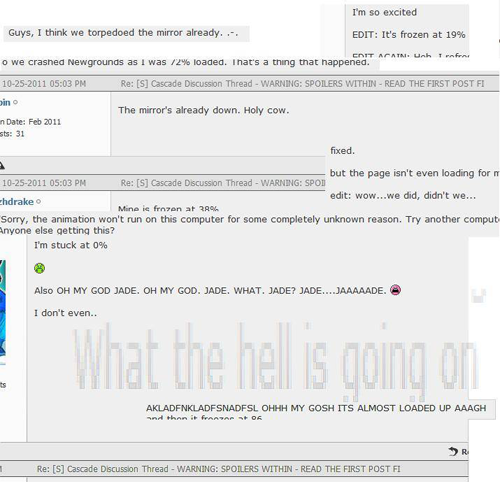
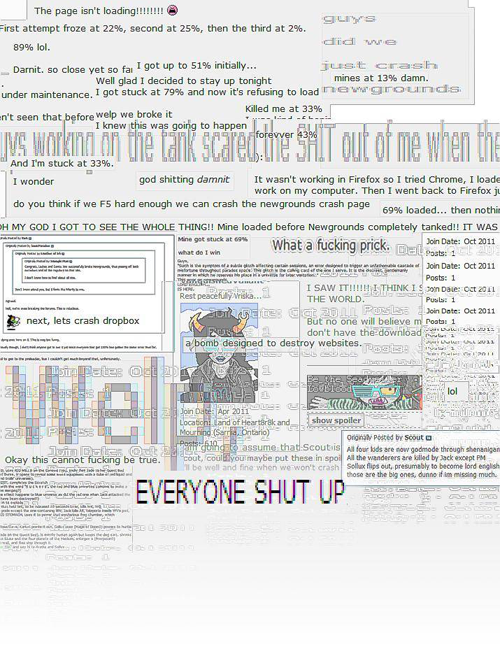
Here’s a wonderful and accurate representation of that night.

imageimageimageimageimageimage

I always felt this didn’t fully encapsulate the entire [S] Cascade experience, because first, this upd8 was something that we had been waiting for for WEEKS. A literally unprecedented wait period at the time. We were used to suckling at the teat of daily updates, a constant stream of conversation and plot twists and buildup, and as EOA5, we were finally going to figure out what all these countdowns and plot threads and disconnected elements were building up for.

And when the progress bar reached 100%, and when the page FINALLY loaded on 10/25/11, it was chaos. This was 2011, a primetime peak point and growth period of Homestuck fan density, meaning hiatus memes were popping up faster than furious fanfictions and fanarts theorizing about what was going to happen next. On tumblr, you couldn’t avoid Homestuck even if you tried, which meant a lot of curious people were constantly starting to read HS to see what the fuss was about, and was a direct precursor to the huge amount of liveblogs that started up after EOA5. MSPA crashed, as it had started to during the last few big [S] updates. Hussie had already bought new servers in advance, but even when allegedly thousands of dollars were spent it couldn’t handle the accidental DDOS attack of Homestuck fans. People were up all night waiting for this upd8, the curiosity was killing me. I know at some point he was receiving at least 1 million unique visitors per day to his site, and even though Hussie had foreseen such traffic and thusly hosted [S] Cascade on Newgrounds, a dedicated video streaming site, Newgrounds was similarly unprepared for the sheer amount of people frantically mashing the play and refresh buttons, and also crashed.

MSPA and Newgrounds crashed definitively for at least two nights in a row, I remember not being able to see the entire update until three days later, even though I kept checking back and refreshing. For a lucky few, the loading bar would stop at 23-30%, where they would then frantically troubleshoot on the MSPA forums and of course, tumblr. For an even luckier few, they could see a tiny bit of the upd8 (spoiler: Jade died) before the whole thing froze, and then when they refreshed and refreshed just like a million other people the whole site disappeared.

Andrew Hussie has gone on record to say this was one of the few times he thought Homestuck wasn’t worth it, because the sheer unbelievable cost (was it $10,000?) of servers and the chaos of no one able to see the upd8 and crashing nearly every site after.

He was tweeting during the whole debacle, stating he was reluctant to put it up on Youtube because of all the moving elements of the flash, and style, and how youtube degraded the quality of the file size, and how he tried to scratch out buffer time and pauses by putting periods of silence between each section of the 15 minute upd8, the longest upd8 yet. It was also a legendarily good EOA, which didn’t help the hype in the least. 

So after Newgrounds patooted, he didn’t put it on youtube and instead put up the entire flash file on Megaupload, where it could be downloaded in it’s entirety to be watched. UNFORTUNATELY, Megaupload also crashed. But before that happened I managed to get the file!

At this point a meme was born. Tumblr also crashed for a few hours in this time period, which I think was in part due to the amount of frantic posting going on, and at least two other sites I can’t remember crashed as well, even definitely Twitter and Youtube briefly? I am positive at least one streaming site crashed when people who tried to livestream the upd8. I went from one video to another trying to get at it, but each one fell into a loading buffer and then subsequently became unwatchable. Many people who were not Homestuck were confused on why all the major sites were suddenly crashing, which was kind of really hilarious because though everyone expected at least two sites to crash, the internet coincidentally went down on that day in the exact order of the HS fandom moving from site to site trying to watch the upd8. 

Spoilers were flying everywhere, people didn’t understand everything that had happened, and by the time the timeline of events was all straightened out, people became even MORE hype. Like this whole thing lasted at least four days, and on top of that, the upd8 was good. Fandom exploded. Almost every super popular homestuck youtube video kind of was born of the excitement right after this upd8, leading into the weirdly ubiquitous 2012-2013 Homestuck fandom phase. But the rest is another story, and [S] Cascade was a humbling and hilarious experience. 

[S] Collide and Act 7 were hosted on youtube (shortly after an official Homestuck youtube was made), after huge hiatuses, so fandom was a lot tinier and Youtube could handle what strain that was left. 

I hope Hiveswap revitalizes something of the intense upd8 theorizing, because it was a lot of fun. 

flintstille:

misterhellboy:

misterhellboy:

i was talking to max about how my hometown in NC has changed since he’s been gone and he pointed out that our town is quickly becoming a wtnv situation. for instance: 

  • apparently our high school, which is 96 years old and looks like a 16th century gothic castle (complete with lion gargoyles), has a fourth floor that no one really knew about until this year. no one knows how long it’s been in the building but from pictures it looks completely different than the rest and has a strange metal staircase in a spiral pattern. 
  • there is also a basement in the high school with a swimming pool but no one is allowed down there and it is starting to rot the first floor.
  • for a good while there was a nice elderly black man that would stand outside of random stores and street corners and dance to make people smile. however, in the past few months he has disappeared and is nowhere to be found.
  • we have a kapstone paper mill in our town and it is regularly normal but some days the smell is absolutely overwhelming and blankets the town like a thick fog.
  • the abandoned movie theater is blocked off to the public but i was talking to some girls from school about it who occasionally break in to chill what it is like on the inside, and they said that there is a giant, bottomless hole in the entrance’s floor so they have to tiptoe across a single plank of wood to get to the other side. 
  • fairly popular places in town will close down for literally no reason. 
  • one time a tornado came through our town and it destroyed the sonic drive-in and a car dealership next to it but no debris could be found. only the empty lots were there. they rebuilt the sonic in less than a month but the car rental lot was kept empty and now bored teenagers harp around it like vultures.
  • one time my grandmother saw an unidentified animal in our backyard. she thought it was a fox but when my dog barked at it, it stood up on its back legs and ran away.
  • fox and coyote sightings are becoming strangely frequent in one single area of town and no one knows why???? its like they all congregate near a horse stable by an old junkyard my cousin used to work at.
  • whenever a dog runs away from home they all end up coming to my house. every dog that gets loose.
  • my grandmother saw an unidentified bird in a tree and i still can’t figure out what kind it was based on her description. 
  • sometimes you can hear random gunshots and loud, unknown bestial screams in the uptown areas

there’s probably more but i don’t really get out much. these are just things that i’ve witnessed myself or is common knowledge in town.

another addition: 

  • everyone forgets our mayor’s name and we’re not sure who our current mayor even is

#this town is a cryptid