Getting older and then looking at all these teenagers who have to save the world…..why did I ever think that was acceptable……..they’re so young….let Katniss sleep…….let Harry Potter have a normal school year……..Aang is literally 12, I’m twice his age and incapable of 1 percent of his plot duties, these poor children, these poor acne encrusted puberty enduring babies
ok but did you forget what being a kid and reading/watching these stories was like? because actual real children do not live lives devoid of violence or responsibility or darkness.
kids have abusive families like Harry and live in poverty like Ron, they live in poverty as part of specific systems designed to keep them keep them there like Katniss, they live in situations that ask way too much of them like Aang and Harry and all of them.
My little sister’s graduating class had a lot of dead parents. There were all kinds of reasons, drug overdose and sudden illness and motorcycle accident and long battle with illness and ’….ehhh probably heart disease? they didn’t do a real autopsy…’. For the long battle with an illness category, Sarah’s mother got cancer not long after giving birth to her much younger sister. Not only did Sarah have to watch her mother slowly lose that battle over the last years of Sarah’s childhood but she had to basically raise that baby because her father was busy trying work and care for their mother. Sarah didn’t have to save the world but you don’t think it didn’t feel like it some times?
It’s like JKR has said, kids don’t hear these stories and suddenly realize monsters are real. They already know. These stories tell you monsters can be defeated. That you can survive. That it might get worse some times but you can win. And yeah it would be nice if in the real world kids never had to do it themselves but that’s just not true.
Harry Potter didn’t make me feel like it was fair or reasonable for teens to save the world, it made me feel less alone in my struggles. Reading about kids fighting the world made me feel like I could make it through too. One of the reasons these stories are so popular is that they give you hope, they give you characters to fight along side during the dark and hard moments in your own life–whether that’s imagining your math test as a Hungarian Horntail you have to get past, or struggling to leave your own abusive family like Harry having to go back to the Dursleys every year, or watching violence and drugs take your friends like the Battle of Hogwarts killed so many.
These stories don’t normalize kids saving the world, they tell kids who already have to that they can survive it.
I Was Always On Green Because My Mama Didn’t Play That Shit.
I got a Red for the first time ever cause I launched a basketball at this girls face 😭😭 it was an accident tho I swear lmao
This traumatized so many kids. I knew someone who had no memory of this until I said the phrase “go flip your card” and suddenly they remembered everything
I went from green straight to red because I gave my friend a piggyback ride for like five seconds
America are y’all okay..?
We had to move popsicle sticks into a green, yellow or red can.
I had to move mine to yellow once for “talking out of turn”.
Literally never spoke up in class again.
This is seriously some fucked up shit, jfc.
it’s funny, because it works as a very effective means of discipline/reinforcement. the concept is simple: instead of the teacher disrupting the whole class and stopping teaching to deal with one person stepping out of line and being, themselves, disruptive, they tell you to go turn your card. then they carry on with the lesson while you do it. kidspawn’s school calls it a point out system. you get three warnings, then you have to log into a book. it takes attention away from the mistake and discourages acting out for that attention.
done properly, it puts the choice in the student’s hands. you know the consequence for an infraction, and you choose whether or not that consequence is worth your action. in a perfect setting, it would only be for actual rules, you spend less time talking to school authority figures, and parents wouldn’t flip out about it unless there was a string of repeated red cards. you don’t double punish, after all.
the best way not to get a red card is not to get a yellow card. it really does benefit everyone in a classroom setting if implemented and respected by all who use it. i find it strange that people find this ‘fucked up’. it’s not corporal punishment, which IS fucked up, and it keeps infractions from taking away from instruction time, robbing other students of their education. loss of instruction time is in no one’s best interest.
and in every setting i’ve seen it used properly (both as a student and as a parent) it works exactly like it’s intended to.
I am a teacher working toward my Masters in education, and I spent my entire kindergarten education and third grade (the only two years I had to suffer through a classroom with one of these boards) entirely on red. The Flip Your Card classroom discipline system is in fact unimaginably fucked up.
At first I worked really really hard to try to keep my card on green, or at least on yellow, but no matter how hard I tried, by the end of the day, my mom was getting a phone call all about how I was a problem. I was regularly stripped of every single privilege my teacher conceivably could strip me of. My third grade teacher gave up on taking away my recess because she just didn’t want to have to deal with me for that extra time, every single day. And every single day, there was a bright red card telling everybody, telling all the other kids, telling my parents, and telling me that I was a problem.
Here’s the thing, no matter how hard I tried, I couldn’t keep my card off red, so it wasn’t this behavior or that behavior that felt like the problem. It just felt like I was the problem.
I did what many kids in that situation do. I gave up. From the outside, it must have looked like I didn’t care that my card was on red, but in reality, I had given up on trying to keep it off red, because nothing worked. It wasn’t apathy. It was hopelessness and despair. In kindergarten, I just checked out and ignored the board. I flat out told my teacher that she could turn my card from then on, because I wasn’t going to. But in third grade, I hit on something worse. Instead of simply pretending the board didn’t exist, I responded to the realization that I couldn’t win by changing the perimeters of what winning was to me. If I was trouble and a problem, I was going to show everybody just how much of a problem I could be. Instead of winning because I made my teacher happy, I won by making everything into a power struggle. Yeah sure, I got sent to the principal’s office and my mom was called, but I didn’t do that thing my teacher wanted me to. Score one for me. That year, I went from difficult to hell on wheels.
This is not actually uncommon, and there are some very good sociological and psychological reasons for why I reacted the way I did. One of the most basic sociological principles is that of labeling theory. This is the idea that people go through life collecting labels, and that these labels affect how we act and how we function in society. People by and large live up to or down to the labels we are given. We can see this in the criminal justice system, where the ways in which we label and treat people, especially juveniles, who commit crimes greatly affects whether or not they will commit a crime in the future, in other words the more someone is treated as a criminal, the more they will act in criminal ways. In a similar manner, being told that you are a bad kid, a troublemaker, a problem, whether outright or through a card system, is liable to convince you of this fact and reinforce that problem behavior. This is one reason why Flip Your Card systems often worsen behavior problems in children with existing difficulties with classroom behavior.
Another failure of the Flip Your Card system is that it has no room for incremental improvement and does not promote reteaching of behavior on the part of the teachers who use it. Most kids with behavior difficulties in the age range where Flip Your Card systems are used are really struggling on learning the rules of behavior and how they should be reacting in a given situation, or learning emotional self regulation. In my case, I had a siezure disorder that wasn’t diagnosed until I was mid-way through third grade, that aside from being misidentified as behavioral problems also prevented me from learning appropriate behavior by damaging my ability to form memories during the period when they were untreated. I also have ADHD, which I can’t treat with medication, because all of them cause me to have siezures. I needed extensive reteaching, and a teacher who was willing to work with me in the moment to help me find better solutions to the situation I was responding to with bad behavior.
Likewise, Flip Your Card systems do not recognize incremental progress. I have a student who just last week refused to come inside when it started thundering, because he wanted to stay outside and spend time talking to his little brother through the fence between the toddler and preschool playgrounds. This is normal for him. Separation from his brother causes him a lot of stress. But I was able to get him to come inside with a little persuasion and a kiss from his brother, and as soon as we were inside, he washed his hands and went to the cozy corner to calm himself down. This is progress. This is in fact the kind of progress that I told his mother about with pride at the end of the day. Once he was calm, I also talked with him about how he should be proud of himself for using some of the skills he was working on to calm himself, and what we could have done differently together outside. Under a Flip Your Card system, his behavior was the kind where he would be required to flip his card to yellow, his progress ignored. What I did instead was to construct a label for him of a student who is working hard on behavior, and affirm for him that I can see the progress and effort he has made. I also established us as partners in helping him reach behavioral and social emotional goals.
Another problem with things like the Flip Your Card system is that much like zero tolerance systems, or any system that are supposed to make things fairer by taking out teacher judgement is that they do not in fact take out teacher judgement. One of the big discussions right now in computing is that the way in which algorithms for job searches or hiring software, or worse algorithms for software used in the criminal justice system, are biased on racial and gender lines, both because of the algorithms themselves and because of the biased information fed into them. This is another example of that. A supposedly unbiased system that becomes very biased because of its nature and because of incorrect input. I already talked a little bit about how students with disabilities that affect their behavioral and social and emotional development are penalized by this system, but another factor is that disabled students, students of color, and especially disabled students of color, are much more likely to be asked to flip their card for behavior that would go unremarked upon for a white or non-disabled student. This is also true of so-called zero tolerance policies. This means that the toxic effects I outlined previously of labeling children as bad fall especially heavily on childen who are already especially vulnerable to being funneled into the school to prison pipeline.
Flip Your Card systems and other similar systems (and throughout this essay I talk about the Flip Your Card system, but Move Your Clip, Name on the Board, behavior charts, and all such similar systems are analogous) also do not promote student choice and autonomy as ouyangdan asserts. They are a classically behavioralist model of classroom management, one that functions on a system of reward and punishments. Reward and punishment systems increase student feelings of powerlessness and decrease their feelings of control. Giving a child a choice between a punishment and doing what you want them to is not giving them a real choice. It’s the same as a bully saying “give me your lunch money or I’ll beat you up, it’s your choice.” These behavioralist systems of classroom management also decrease students’ intrinsic motivation to behave, and replaces it with an extrinsic modivation. This can be seen in my case when my intrinsic modivation to try to behave for my teacher and my fellow students was overriden with the extrinsic modivation of the Flip Your Card board, which didn’t work because I gave up on avoiding the punishment. With my intrinsic motivation leached away and the extrinsic modivation proving ineffective… But this can also be seen in kids who behave well in class. Instead of learning the whys of good behavior and learning to regulate their emotions and reach consensus, and other skills of living in civil society, they learn that to be good is to be obedient and avoid punishment, to please the person In Charge. This is what happened with @thecityhorse higher up in this thread. They learned that speaking up in class brought pain, so they stopped, at a detriment to their education and their psyche.
So why are behavioralist approaches like the Flip Your Card chart so popular? One reason is that for most students they work in the short term very well. Humans like to avoid humilation and pain. This makes them convenient for teachers to implement, even if they cause other problems. Another reason is that they look fair to most adults even though they are not. Also it’s impossible to discount how thouroghly we as a society believe in certain ideas about a child’s place as obedient and subservient to adults, especially parents and teachers, and view enforcing this idea as a good in and of itself. Most people, even teachers, who absolutely should know better, and have in fact been learning better in teaching programs for decades, don’t step outside this paradigm. Behavioralist systems of reward and punishment reinforce this obedience.
Behavioralist approaches to classroom management are so normative that it can be hard to think about what the alternatives to them are, and when I talk to people about the alternatives to behavioralist methods, they express scepticism about the effectiveness of these methods. The biggest method I use is to get to the root of a behavior. Johnny screems during play, which causes Tommy to hit him. Tommy gets scared when Johnny screams in a way that seems aggressive, so we work on reading body language and what to do when we’re scared. Johnny screams because he gets wound up and overwhelmed playing chase, so we work on stopping and leaving the game before he gets that overwhelmed. I do a lot of teaching my students to recognize and name their own emotions, and recognize and name each other’s emotions, and think about what caused those emotions. I teach them ways to calm down, to get what they want and need in acceptable ways, and I build a relationship of mutual respect in which they want to do things for me and for their classmates because they care about us. This is that intrinsic motivation I talked about. And yes, many of the kids I work with have some pretty severe behavioral challenges. This was also the method that worked with me as a child. My fourth and fifth grade teachers both worked hard to develop relationships of trust and respect with me, and worked with me on processing my emotions and understanding the needs and feelings of others. This method really does work, and it promotes empathy, self-awareness, and moral self-reliance, which are important lifelong skills.
YES, all this.
The year I was in 5th grade, we had “the stick system,” which was a lot like this – you start each week with 5 sticks in a little pocket, and for every infraction you have to take one out and put it in a jar. If you ended the week with 5 sticks, you got a prize (a sticker or a piece of candy). With 4 sticks you didn’t get the prize, but there was this recess period on Friday afternoon that was like 1.5 hours long, and you got to have recess the whole time. For every stick after that, you lost some time in recess and basically you had to be in time out instead; you’d sit in a classroom quietly and do nothing for up to 90 minutes. Because the best thing to do with a kid who can’t behave is make them sit still and do NOTHING for a longer period than they can basically conceive of, instead of making them run in circles on the playground.
I was a very quiet, lonely kid; I have ADHD which was actually pretty debilitating as a kid. Basically I found it impossible to do anything except read novels and fight with my sister. So I would always lose my sticks for forgetting to do my homework, zoning out in class, being quietly and oddly disruptive… I never. EVER. had any sticks left at the end of the week. Actually I think once I ended the week with 1 stick, and I was SO proud of myself…and all the other kids usually ended the week with 4 or 5, so the teachers were like “ok so you failed slightly less than usual. Good job?? Now do your fucking homework.” (I paraphrase but that was basically the sentiment.)
The thing is, I was SO EAGER to be liked – by anyone! Classmates, teachers… my classmates just thought I was weird, but my teachers actually liked me most of the time, they just found me really frustrating. Which, fair: I also found myself really frustrating. One time my science teacher was collecting homework, and I (as usual) did not have it. So she gives me this completely fed-up look, and says, “Okay. Well…(sigh) go take a stick.” Completely done. And I have to tell her “I don’t have any sticks left.” She just stares at me for a few seconds, then literally throws her hands up and walks away. And I wanted to DIE. But I didn’t know how to react to that, so I was just stoic.
Maybe she thought I didn’t care, but it was just the opposite – I was this little 9 year old kid who constantly felt like the world was ending because I could never do anything right. I wanted so badly to be good, and I was incapable of doing what they wanted. But they still used the stick system with me, even when it was very clear that it had no effect on my behavior. To this day, I wonder why, after like a month of this technique completely failing to help me or them, they didn’t just scrap it and figure out something else. Was it too much work to teach me? Was it easier to just keep setting me up for failure?
Here’s the rest of that story: the next year, my 6th grade teacher told my mom I’d never graduate from high school (my mom was like “ok challenge accepted you bitch”. Good mom.) Two years later I was given a period of “resource room” every day (basically special ed) where I learned stuff like organization and study habits and refocusing when you zone out (WHAT?! MAGIC!) And then I graduated from high school, got into and graduated from a very good college, got a master’s degree, and then I decided to go into medicine so I took a bunch of science classes and got myself into medical school. Just started my 2nd year, and I did quite well last year so GO FUCK YOURSELF MS FISHER. I did TOO graduate from high school and guess what the fuck else! (…actually she’s probably dead by now so whatever).
My 5th grade teacher, though, the one who had the stick system? She really liked me and wanted me to succeed. She worked with me a lot, but either she didn’t know how to do it right or I wasn’t ready. But they never thought of stopping that stupid system. I still wonder what that year (and subsequent years) would have been like, if they hadn’t let me turn myself into the bad guy in my own life. You should never make a kid feel that crappy.
eff everyone who thinks what attackfish wrote is a “waste of education time”! And the flip your card system and similar ones really are bullying and often it’s like “give me your lunch money or I’ll beat you up” but the kid doesn’t even HAVE any lunch money to begin with, because no one gave them any. Like, it’s not a CHOICE to “behave”/be dismissive and obedient, for a lot of children who literally can’t do that. And shouldn’t have to either because fuck obedience!
This is actually really good for babies’ brain development. You’re laying the groundwork for conversation, teaching them through example that people take turns talking and listening.
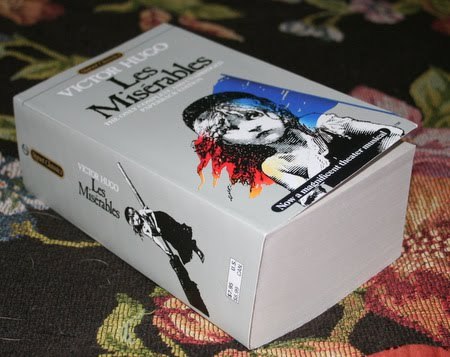
Did you know that babies from affluent families hear an average of thirty MILLION more words before age 5 than babies in families below the poverty line? For context, Les Miserables is about 650,000 words and it looks like this:
So it’s like reading this book 46 times.* And that’s not the total number of spoken words, that’s the GAP between affluent and poor babies. And these are the years in which the brain undergoes the most development. It’s mind-boggling.
So what I’m saying is: keep doing the thing. Do it to all babies, all the time. Narrate your day. Ask them for opinions. (“Should we buy the large bag of potatoes or the small bag?” “Gaabooglagje.” “Yes, just as I thought.”) Point out colors and shapes and letters. Let them scribble outside the lines and treat their babble like talk. Sing them nursery rhymes and Raffi songs and songs from the radio. All of these things are going to build their brains to prepare them for kindergarten and beyond.
*Please do not read Les Mis 46 times to an infant. They don’t even care about the Parisian sewer system.
And they never will with THAT attitude
Actually the “word gap” study is kinda garbage, with crap methodology and so, so many structural flaws that all you can really say about it is “their science is bad and they should feel bad.”
Also kinda racist, pretty ethnocentric, hella classist, weirdly privileges Anglo-monolingualism (which is absolutely counter to like … all the other research, ever) and generally not a great thing to use as your frame:
Michaels says, “The deeply destructive, pernicious thing about the Hart and Risley study is that it presents what seems like totally rigorous, careful, objective science (what under careful inspection is nothing more than pseudo-science)—that gives teachers, educators, policy makers the ‘proof’ they need to believe that these poor kids aren’t smart, aren’t good learners, don’t have adequate language to think well with” (p. 35). As librarians, when we cite the 30 Million Word Gap, we run the risk of continuing to enforce the bias and classism that this study did, as do some of the initiatives that have cropped up around this study. “In effect, the word gap interventions propose that improving social and economic outcomes for poor and minority families can be as simple as training them to act more white and middle-class (and monitoring their compliance with a ‘word pedometer’)” (Saiyed, 2015). While Babies Need Words Everyday does not go as far as to install word pedometers on parents, and instead simply encourages them to speak with their babies, the issue is very different – but by using word gap and deficit thinking, we may be treading in dangerous territory.
Also they, like. LITERALLY coded their data-analysis so that only “good” word-interactions were counted, where “good” = “matched white American middle-class politeness structures”. I am not even joking.
I super recommend reading not only the ALSC post I linked above, but also a lot of the stuff she’s linked in it
That said, talking to your babies is a great idea! Interacting with babies is fantastic! It’s very good for them. You’re modelling communication and helping to build actual literacy skills, and the more you can do that, the better. They don’t actually need to “understand” exactly what you’re saying: the point, as the poster above correctly notes, is that you’re establishing how communicating by language works, what the STRUCTURES of communicating by language are, and all the other things about how it works.
It’s the framework of that stupid study that’s pathological in a lot of ways: firstly the idea that you can hammer the whole thing down to numbers of words at all (which is a bad idea and ignores visual literacy and other factors that are extremely important to both language acquisition and emergent literacy when they’re older which can often be much more important than straight up word-exposure) and the idea that somehow just sheer volume/quantity of vocabulary is the important part; secondly the idea that this is intrinsically linked to poverty or working-class status (see: deficit thinking above); thirdly that it’s useful to frame this as “omg SOMETHING IS HORRIBLY WRONG HERE IS WHAT YOU MUST DO TO FIX IT!” rather than “hey you know what’s important and awesome for your kid? talking to them and interacting with them and mimicking and back-and-forth like conversations with them! Do it lots!”
TEAL DEER: Yes that pattern is totally great, continue to talk to your babies like that! But at the same time, the word-gap study is garbage and toxic and should not be cited!
Petition to fucking salt and burn the concept of “attention-seeking behaviour” as something intrinsically bad in children
To elaborate: If a child especially* is seeking attention, it’s because they fucking need some attention. “Attention and interaction from adults” is a non-negotiable neurological need. It is as important as food and water and clothing and a place to pee.
There will be times when a child seeks attention that are Unfortunate, either because now is not a good time for attention, or because the manner in which they are trying to get the attention is Unfortunate. See also “TALK TO ME WHEN YOU ARE ON AN IMPORTANT PHONE-CALL” and “I WILL GET YOUR ATTENTION BY SCREAMING AND BREAKING YOUR STUFF.”
But here’s the trick: if they are seeking attention then, and in that way, that means that they are not getting attention they need otherwise. And not reinforcing the bad behaviour is only half the solution. The other half is giving them attention in other ways and responses to other things.
If the only way that a child gets attention is by acting out? They will act out. Their all-powerful lizard-brains (which are absolutely, in children, VERY POWERFUL) will eventually literally just see the negative consequences of the behaviour as the price to pay for getting the attention their brains absolutely need as much as their bodies need food and water and to take a piss.
You cannot get out of the absolute responsibility to give a child under your care regular positive attention and interaction. If the child under your care is starting to show bad attention-seeking behaviour? That is a fail-proof diagnostic that on some level that child is not getting the attention and validation they need.
This does not mean that you do things that will tell them “yes, behaving this way will get you good attention.” But it does mean that you need to start showing them how to get more good attention from you.
You have to start teaching, “No, you cannot crawl all over me when I’m on the phone – but when I hang up the phone you can come ask for a hug or for me to look at your drawing”. YOU HAVE TO DO BOTH PARTS OF THIS. If you need a child to stop doing things like Making Messes for Attention, you have to start GIVING THEM attention for good things (and you know you might have to start at the very very bottom of the rung with “thank you so much for not making a mess today! Let’s play hide and seek!” Or something similar, but TOUGH SHIT, YOU ARE THE GROWNUP, THEY ARE THE CHILD).
… and if the child in question is younger than 12 (well really 18 at least, but DEFINITELY 12) months just fucking pay attention to them, they don’t have the cognitive capacity to understand putting off fulfillment, ok?
You know what the WORST THING possible for a baby to start doing is? Not trying to get adult attention.
Because that means that their brains have decided that you have abandoned them in the grass for the hyenas to eat, so they’re just going to stop developing and start dissociating. And this ends up with attachment disorders that will actually cause the child great difficulties in later life.
If a baby is crying and honestly distressed, fucking soothe it already.
(nb: yes, to some extent babies do need to learn to self-soothe; this lady has an actually sane article about this process which is a miracle, which gets into more detail about the processes involved and how it is a PROCESS, not just leaving the baby there to cry itself into hysterical exhaustion and teaching it that you won’t respond to its needs. PROCESS.) (nb2: sometimes the sleep/soothe process also gets into genuinely Medically Complicated Territory at which point you should be working with an actual paediatrician with specific training/etc, and you STILL don’t just leave the fucking baby there to scream for hours, trust me).
This has been your swear-filled elaboration of a friend’s aggravation for the day. Tip your server.
*adults also need attention, but adults are, well, adults: it is in fact their own responsibility to figure out how to seek attention from people who have the capacity to give it to them, at times that are good for everyone involved, etc. Children, however, are damn well children and it is the responsibility of caregiver adults to fulfill their needs and TEACH THEM how to fulfill their needs as they grow.
*holds a lighter aloft*
That is such a good rant, I adore it and welcome it and validate it! raising a cub of my own, and caring a lot about attachment theory, has really put this into practice in concrete ways. You can actually OBSERVE the cub needing attention to make their brain grow. (sometimes, when I don’t have anything left to say/give, but the cub needs attention, I just smile and burble repeatedly, “Warm eye contact! Warm eye contact to make your brain grow!! Yeahh! Warm eye contact! Positive attention!” because I’ve run out of things to say, but the baby doesn’t know that yet, ho ho ho)
But Discoursing away from baby development, one thing I always question is the CONTEXT for which people dismiss behavior as attention-seeking. It’s always cast as this terribly bad thing, “attention-seeking,” as if people noticing you is this corrosive thing that damages you and everyone around you. This thing that should be punished, by denying attention, like:
“Ugh! how dare you exist!”
“I really hate it when babies have needs!”
“The worst part is when babies have needs and they EXPRESS them.”
“She has dyed her hair a noticeable color. Probably because she didn’t get enough attention from her father, and she is now trying to use her hair to STEAL ATTENTION from everybody else.”
“That outfit, which shows some skin, has attracted my attention – isn’t that awful? They should be punished, for using their visible skin to seek attention.”
“How dare you blog, where I can find it and see it with my own eyes.”
“Why are you EXCELLING at something? Ugh! Always doing it for attention.”
“Why are you FAILING at something? Ugh! Weren’t you getting ENOUGH attention?”
“That sounds complicated. I think you’re making it up. Making it up for attention.”
“I went somewhere and – can you believe this – there was a young person, quite a young human, MAKING A NOISE, where I could hear it, and their caretakers did not forcibly stop it from doing so!! Honestly. People should be licensed before they have children.”
“I just saw a reminder that some people use special accommodation [blue badge/designated parking spot/baby on board sticker/service dog/etc] and I am just so SICK of people rubbing their CONSTANT need for attention in my FACE.”
You know how in Harry Potter, whatever Harry does, his bullies and abusers say that he’s doing it for attention, so they dismiss it and mock it? If he publicly has ANYTHING, from a mild compliment to a broken limb – “Weren’t you getting enough attention, Potter?”
“Look at you EXISTING, Potter. Were you hoping to form some kind of human connection? Did you think you could exist, and occasionally need things? Well, we’ve seen through THAT pathetic ploy. REQUEST DENIED.”
It’s pretty weird, is what I’m saying. It’s kind of a thing that shitty people say.
Anyway, I’ve found it pretty liberating in my life (and good for my mental health!) to question this. Why is attention-seeking positioned as bad? Why is asking for it a good reason to be denied it? Why are certain people denied attention, such that everything they do is cast as a desperate ploy to acquire the attention they are not entitled to? How exactly does the existence of crying baby, a woman’s pink hair, or a blue badge apparently manage to suck all of the air out of the room?
Given that we are social animals who require positive attention to grow, maintain relationships, keep our mental health and do our jobs well, what’s so bad about giving it to people?
Given that so many humans are raised in such a broken way that they seek negative attention – resulting in terrible things and a broken world – what is even so terrible about people explicitly asking for attention in a positive way, with something like brightly colored hair, or by creating a piece of art for others to see?
Why is attention-seeking intrinsically bad?
In my experience this seems to be really tied in with oppression and increasingly affects marginalized groups. This absolutely includes children and minors, who most people don’t even recognize as an oppressed class, but also look at how often queer/lgbt people even mentioning their gender or sexuality gets painted as attention seeking. Or women and PoC try to talk about sexism and racism and they are accused of creating “drama” for attention. Victims of abuse are gas-lighted by being told they’re making it up for attention. People with mental or physical disabilities are seeking attention for needing access or accommodation. Marginalized animals are frequently just outright killed for exhibiting attention-seeking behaviors.
It’s a silencing tactic and a way to exert power and control over others who you think should be doing everything the way you want without taking their needs into account. It starts in infancy, and it gets so drilled into us throughout our lives that it becomes internalized and many people learn to silence themselves because they don’t want to be seen as one of those “attention seekers”.
stop the phrase “tattle-tale”. stop indirectly telling kids that if they speak up about someone that’s bothering them, they’re doing something bad. stop contributing to the culture of abuse.
seriously though this NEEDS to stop. my mother. a grownass woman of 59. had to ask me over and over again if I was sure it wasn’t ethically dubious for her to go to her employer and report harassment and terror tactics from a coworker because she didn’t “want to be a tattler.” stop teaching kids not to be “tattle-tales” because they will not grow out of it.
This this this.
I hope this is okay to add but in addition to the above it can create immediate and dangerous problems for children, with other children.
When I was six years old, one of my first grade classmates bullied me relentlessly for a long time. When I tried to tell the teacher that he wouldn’t stop touching me, she told me that I was being a tattle-tale and disrupting the class. So he got worse and worse. Before I knew it, he was telling me that I had to let him destroy my school supplies because his daddy told him that women have to obey the word of men. The bullying culminated in him and his friend waiting until the teacher and all the other kids left at the end of the day, cornering me at my desk, then threatening to bring his dad’s gun to school and shoot me if I didn’t stop wearing my favorite boots.
I didn’t tell the teacher because that would have been ‘tattling’. I didn’t tell my parents until they asked why I was upset that night. I wound up talking to the principal with my dad, and the principal was shocked that I had been too scared to report a shooting threat.
I know that a lot of people might think a kid would definitely report something like that, but I didn’t. A lot of kids don’t. Please, please give kids the chance to tell you if something is wrong, don’t brush them off, make sure they know that they can come to you for help. Don’t make them think they’re a burden or a ‘tattle-tale’.
And you might think, “Oh, well kids should know the difference between tattling and getting help, they should know when something is important and when it’s not. They should know better.”. They don’t. A 3 year old does not know he doesn’t need to cry when he wanted the blue jelly bean or if the thing he’s trying to do doesn’t work, those things are important to him and he is expressing himself in the only way he has ever known and it is your job to teach him how to manage his emotions, not internalize them because they “aren’t important”.
Little kids don’t know what’s important and what’s not. As they get older they learn, but if you just tell them to quit complaining and deal with shit, that’s what they’ll do until it’s bigger shit that does matter and now it’s your fault that your kid feels like he/she can’t express themselves when frustrated or scared or angry or whatever. You might think “Well, he’s 5 now, he should know.” Just, inherently? By osmosis? Did you even hold a child-rearing book against his head to increase the chances of successful osmosis? NO? Then I’m guessing you didn’t teach him that his feelings are valid but there are appropriate and effective responses, and which those are.
Also: Stop bullying your fucking kids into being bullies. “Man up” and “Deal with it” are not appropriate parenting techniques. You just told your kid that his/her problem doesn’t matter and they should just cram it deep down and stop bothering you with their emotions.
Yeah, you’re old as fuck and your kid’s problem seems stupid and asinine, but your kid isn’t old as fuck and that problem is new and they don’t know what to do about it. Don’t be a dick.
It is an unspoken rule that if a little kid is hiding under a blanket or couch cushions, you are required to comment on how lumpy the blanket is and pretend to sit on it to try and “smooth it out.”
Also, if you’re playing hide-and-seek with them, it is critical that you search every other possible (and impossible) hiding spot, all the while wondering out loud how they managed to disappear just like magic, before walking right past their hiding spot.
And if a baby starts playing peekaboo you are required to act surprised when they show their face again
If a kid hands you a phone, you answer it
If a kid shoots you with a Nerf Gun you are supposed to Die a dramatic death and explain “ugh you shot me blaahh”
when you push a kid on the swings ya gotta do the woosh
I literally just blocked about a dozen people on this post for being cranky about children.
Being a joyless shitbeast to kids isn’t cool. They’re kids. If you want to be Oscar the Grouch, that’s fine, but do it in a way they understand and explain it to them.
“I don’t want to play, I’m grumpy. Thank you, though, that was kind.”
It’s literally not hard. Kids are small people. Treat them with common fucking decency.