is there a word for “i was instantly good at a lot of things as a quote-unquote gifted child, and, as a result, i was able to skate by without ever being taught how to actually learn a new skill, and now that i’m an adult trying to learn new things that i can’t be good at instantaneously, i don’t have the patience or knowledge to improve on them, because skills that don’t come naturally to me just make me angry because i lived off instant gratification my whole childhood due to not ever being challenged intellectually or taught basic learning skills?” asking for a friend
people like this piss me the fuck off
why does everyone refuse to consider the possibility that maybe an education system designed from the ground up to turn intelligent and creative children into mindlessly efficient factory drones might have a negative effect on the people it deems (correctly or not; usually not) to be more intelligent and creative than average?
we were punished for “learning too fast” by having the lessons about how to learn taken away from us, and by couching it all in positive language so that our peers would resent and isolate us. literally all of us know we’re not better than anyone else, but that doesn’t seem to matter in the face of “i was jealous in elementary school and have held on to that for 15+ years.”
when we say things like “i don’t know how to learn things that i don’t immediately understand” you hear “i was that kid you hated because i never studied but i always got a 100% on the test anyway,” but what we mean is:
i have a vague understanding of what a flash card is, but no idea how to make them or what to do with them
i have literally no idea how to take notes because:
i don’t know what i’ll forget if i don’t write it down
i don’t know how to pay attention to what’s being said while i write
i wouldn’t know what to do with the notes anyway
if i don’t understand something, i don’t know how to formulate a question
i don’t know how to recognize when i don’t know something until it goes wrong, at which point i don’t know how to identify what i did wrong
i can’t tell the difference between a mistake that’s part of the learning process and a mistake where i should know better
but yeah, if we ever acknowledge any of this, we’re definitely just being ungrateful whiners who don’t realize how good we had it when we were 7
Don’t forget that:
Gifted children sometimes get explicitly punished for being smart, either because the teacher resents the kid (especially if the kid is getting some sort of special advancement), the teacher thinks the kid is cheating (I once got a zero on an assignment in middle school for finishing it too fast), or they act out because they’re bored out of their minds (incorrect ADHD diagnoses aren’t uncommon, especially among underprivileged kids).
And when I say “bored out of their minds,” I mean “there were times when I got physically ill before school because the thought of another day of that was soul-crushing.” Anything in school that was so boring you felt like your brain was turning into porridge? The easier the work is for you, the more of that feeling you get.
Gifted children often end up with perfectionism complexes, because they’re constantly taught that high grades are the most important and valuable things about them, and anything less than a 100% is a failure. This can easily lead to crushing, crippling anxiety and self-sabotage when they hit something that’s genuinely hard for them, because you’re supposed to be good at this, and if you’re not, there’s nothing left.
Gifted children with mental illnesses or learning disabilities are in for a special hell, because nobody wants to admit they exist. Good grades are used as evidence that you’re not trying hard enough, and disabilities are even more likely to be treated as moral failings than they are in non-gifted kids. Just off the top of my head, I personally know:
Someone whose daily, violent panic attacks were written off by the school as “acting out for attention” because when they didn’t have a panic attack, they had no problems with the work
Someone whose previous teachers would warn the next teacher to have her each year not to seat her next to the window or anything that made noise because if you did she’d get distracted and never listen in class, but when the possibility of ADHD was raised by her parents, all the teachers insisted that couldn’t be true, because she got good grades
Someone who, while at a gifted school, asked for accommodations for their mental illness, and was refused because “you shouldn’t be handicapping yourself like that”
Someone who went to a school counselor for suicidal ideations and was blown off because their grades were good
And that’s not even getting into the interaction with, say, dyslexia or dyscalculia.
A very, very high proportion of the gifted ex-kids I know (and I know quite a few) are dealing with a cocktail of depression, anxiety, and often at least one other mental illness that wasn’t diagnosed until they were out of school. Many of them crashed catastrophically in college, either because they were never taught basic learning skills or because they burned out under impossibly high expectations. Hell, I know a guy who started college at 13, graduated it at 17, got a bunch of achievement awards from gifted organizations, and was homeless at 20.
The school system sucks for everyone. Just because someone got higher numbers written on their papers doesn’t mean it sucked any less for them. It just might suck in a slightly different way.
hot take: autistic people shouldn’t have to disclose that we’re autistic in order not to get mocked for our behaviour
what i mean is i’ve seen/experienced way too many times where someone’s being ridiculed over doing something harmless and when the people doing the mocking find out the person’s autistic they’re like ‘ooohhh…….. well i didnt know…’ and apologize. like? at that point it doesn’t even matter if the person is autistic or not, if you’re making fun of autistic behaviour you’re making fun of autistic people, period. either you’re an asshole or you’re not, and autistic people shouldn’t have to inform everyone that we’re autistic in order to get some sympathy and be allowed to exist as we are without getting made fun of
This is actually really good for babies’ brain development. You’re laying the groundwork for conversation, teaching them through example that people take turns talking and listening.
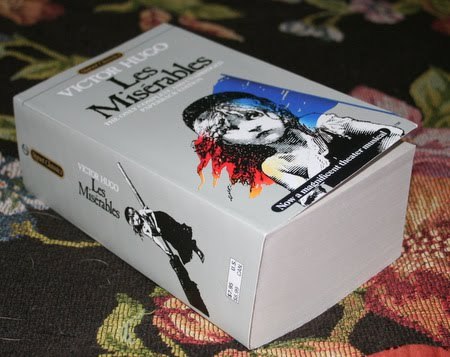
Did you know that babies from affluent families hear an average of thirty MILLION more words before age 5 than babies in families below the poverty line? For context, Les Miserables is about 650,000 words and it looks like this:
So it’s like reading this book 46 times.* And that’s not the total number of spoken words, that’s the GAP between affluent and poor babies. And these are the years in which the brain undergoes the most development. It’s mind-boggling.
So what I’m saying is: keep doing the thing. Do it to all babies, all the time. Narrate your day. Ask them for opinions. (“Should we buy the large bag of potatoes or the small bag?” “Gaabooglagje.” “Yes, just as I thought.”) Point out colors and shapes and letters. Let them scribble outside the lines and treat their babble like talk. Sing them nursery rhymes and Raffi songs and songs from the radio. All of these things are going to build their brains to prepare them for kindergarten and beyond.
*Please do not read Les Mis 46 times to an infant. They don’t even care about the Parisian sewer system.
And they never will with THAT attitude
Actually the “word gap” study is kinda garbage, with crap methodology and so, so many structural flaws that all you can really say about it is “their science is bad and they should feel bad.”
Also kinda racist, pretty ethnocentric, hella classist, weirdly privileges Anglo-monolingualism (which is absolutely counter to like … all the other research, ever) and generally not a great thing to use as your frame:
Michaels says, “The deeply destructive, pernicious thing about the Hart and Risley study is that it presents what seems like totally rigorous, careful, objective science (what under careful inspection is nothing more than pseudo-science)—that gives teachers, educators, policy makers the ‘proof’ they need to believe that these poor kids aren’t smart, aren’t good learners, don’t have adequate language to think well with” (p. 35). As librarians, when we cite the 30 Million Word Gap, we run the risk of continuing to enforce the bias and classism that this study did, as do some of the initiatives that have cropped up around this study. “In effect, the word gap interventions propose that improving social and economic outcomes for poor and minority families can be as simple as training them to act more white and middle-class (and monitoring their compliance with a ‘word pedometer’)” (Saiyed, 2015). While Babies Need Words Everyday does not go as far as to install word pedometers on parents, and instead simply encourages them to speak with their babies, the issue is very different – but by using word gap and deficit thinking, we may be treading in dangerous territory.
Also they, like. LITERALLY coded their data-analysis so that only “good” word-interactions were counted, where “good” = “matched white American middle-class politeness structures”. I am not even joking.
I super recommend reading not only the ALSC post I linked above, but also a lot of the stuff she’s linked in it
That said, talking to your babies is a great idea! Interacting with babies is fantastic! It’s very good for them. You’re modelling communication and helping to build actual literacy skills, and the more you can do that, the better. They don’t actually need to “understand” exactly what you’re saying: the point, as the poster above correctly notes, is that you’re establishing how communicating by language works, what the STRUCTURES of communicating by language are, and all the other things about how it works.
It’s the framework of that stupid study that’s pathological in a lot of ways: firstly the idea that you can hammer the whole thing down to numbers of words at all (which is a bad idea and ignores visual literacy and other factors that are extremely important to both language acquisition and emergent literacy when they’re older which can often be much more important than straight up word-exposure) and the idea that somehow just sheer volume/quantity of vocabulary is the important part; secondly the idea that this is intrinsically linked to poverty or working-class status (see: deficit thinking above); thirdly that it’s useful to frame this as “omg SOMETHING IS HORRIBLY WRONG HERE IS WHAT YOU MUST DO TO FIX IT!” rather than “hey you know what’s important and awesome for your kid? talking to them and interacting with them and mimicking and back-and-forth like conversations with them! Do it lots!”
TEAL DEER: Yes that pattern is totally great, continue to talk to your babies like that! But at the same time, the word-gap study is garbage and toxic and should not be cited!
You can get to the point where you can express yourself in a language by learning basic grammar and just 200 words.
My test for being able to express myself is: Can I keep a diary in this language? Can I talk about what I did today and my opinions on just about any subject?
Too often, people who have been learning a language for months or even years say “no.” However, in my experience, it’s possible after learning just basic grammar and the 200 most useful words. If you wanted to go fast and learn 20 words a day (the default rate of Anki), then you could learn 200 words in a week and a half. (In my experience, learning basic grammar doesn’t take as long as learning the words, so the total time could be three weeks. However, I didn’t teach myself my first foreign language, so I can’t speak to that case — if you’re teaching yourself your first, kudos, and let me know how long the grammar takes!)
The key is that you have to learn the right 200 words. When I was teaching myself languages before, I could never find a good answer to the question: What words should I learn first? If you use Duolingo, they’ll start by teaching you words like “apple”, which aren’t very useful. I spent a lot of time writing and talking in order to determine which 200 words would let you express the most. I think I finally got it. But don’t take my word for it — see this demonstration.
I personally tested this method out with Esperanto and French and I’m now able to keep a diary in both languages, writing about anything that happened in my day and any thought that crosses my mind.
To be clear: 200 words won’t make you fluent, but they’ll allow you to express yourself, and it’s a lot easier to keep improving from there. Feel free to adapt the method based on what works for you. Here are the steps:
If your language uses a non-Latin alphabet, learn the alphabet.
Practice writing (This method is introvert friendly! You don’t have to talk to strangers if you don’t want to. But at this stage you can also practice by speaking, if you prefer.)
If you have any questions, feel free to ask. Also, please send me your feedback! I’d love to know if this works for you or if it doesn’t. I welcome all comments, criticism, and suggestions for improvement. And if you think this guide could help other people, please consider reblogging it. 🙂
Additional notes:
To be able to express yourself with 200 words, you’ll need to be able to rephrase things: e.g. “she comforted him” = “she caused that he felt better”. Even if it’s hard for you to rephrase things this way, the 200 basic words are a great starting vocabulary list.
This is the order in which I usually learn an alphabetic language: basic writing and speaking, reading, listening, advanced writing and speaking. Being able to express yourself doesn’t mean that you’ll immediately be able to listen to the language and understand it, because native speakers may speak fast and use a wider vocabulary (though hopefully they’ll slow down and simplify for you in a conversation). But it’s a lot easier to keep improving from a point where you have basic writing and speaking skills than from one where you don’t.
you decide to take care of yourself and to stop using chunks of Mental Health Time to study instead. your days begin to shrink uncontrollably, from 24 hours to 20 to 15 to 10, until you have no other choice.
‘i’m not going to give this my full energy, it’s only 15% of my grade,’ you tell yourself. three days later you’re in agony as the assignment looms over you, demanding you make it better. it won’t let you go.
‘i just want one more day to my week-end,’ you sob pitifully as you eat your instant noodles. that day never comes. your week-ends remain terribly short, monday finds you exhausted still, and you’re not sure how much longer you can carry on like this. you’d rather not think about it.
you skip a one-hour class to study more. four hours later you find yourself cursed, deep in the recesses of youtube, having accomplished less than you would have if you’d attended.
‘maybe i could order a pizza to get a good meal tonight,’ you say to yourself. your phone turns into a mass of writhing snakes before you can grab it. you eat an entire box of dry cereal instead.
the one-week break begins tomorrow, a saturday. you sigh in contentment, blink, and find yourself in your 8am class the monday after. you don’t know how that happened. you’re not sure you want to know.
you’ve been top of the class all through college. it doesn’t seem real. you graduate. it doesn’t seem real either. you receive your diploma and pin it on the wall. it disappears instantly. your memories of college are dim and hazy. it doesn’t seem real. ‘what was it all for again?’ you ask. no one answers.
me, 5 weeks ago: i just bought a courgette!!
me, 4 weeks ago: damn i should prepare that courgette that’s been sitting in the fridge for 1 week
me, 3 weeks ago: damn i should prepare that courgette that’s been sitting in the fridge for 2 weeks
me, 2 weeks ago: damn i should prepare that courgette that’s been sitting in the fridge for 3 weeks
me, 1 week ago: damn i should prepare that courgette that’s been sitting in the fridge for 4 weeks
me, now: damn i shoul



 queerhomestuck